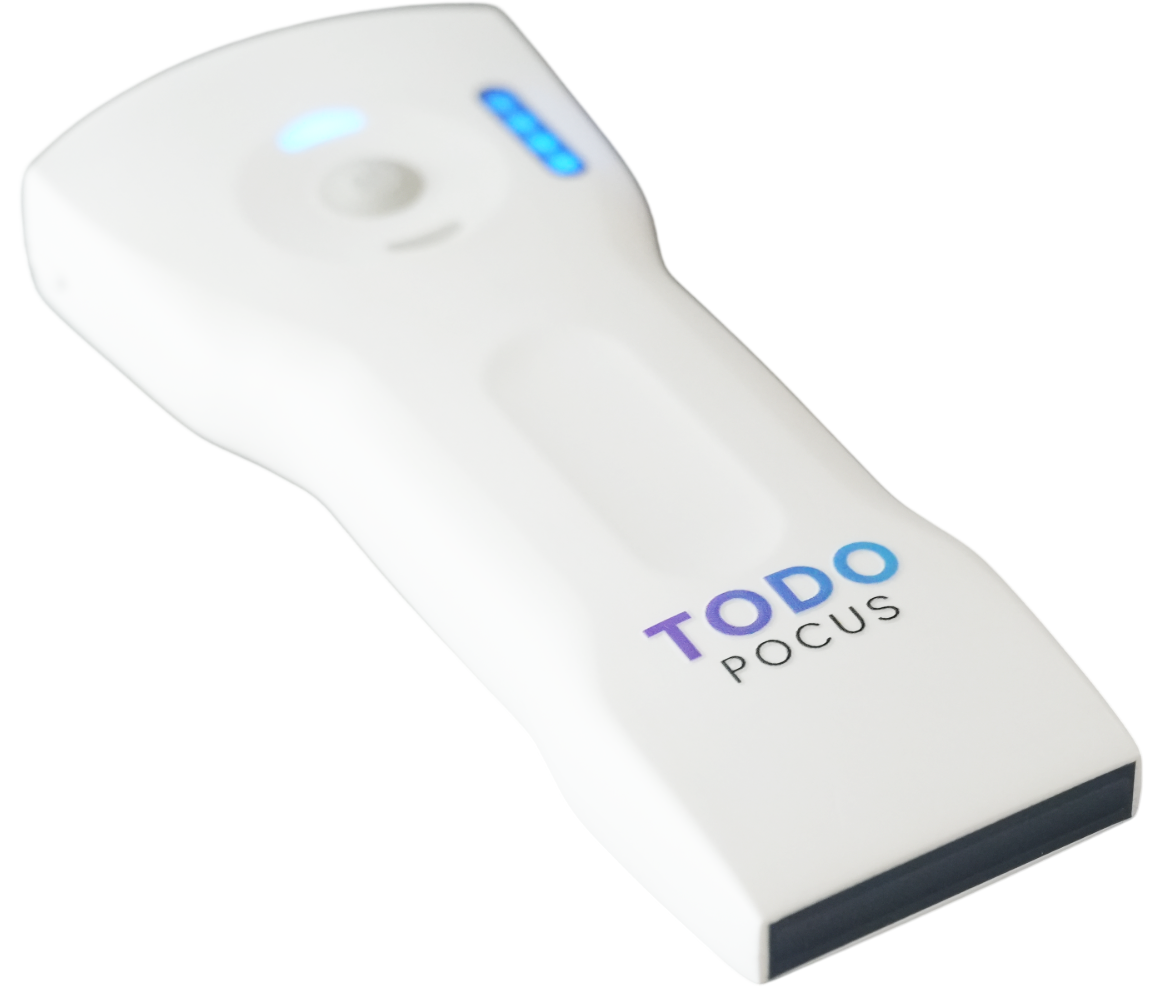














Philips Lumify Alternatives in 2026: Best Options by Probe

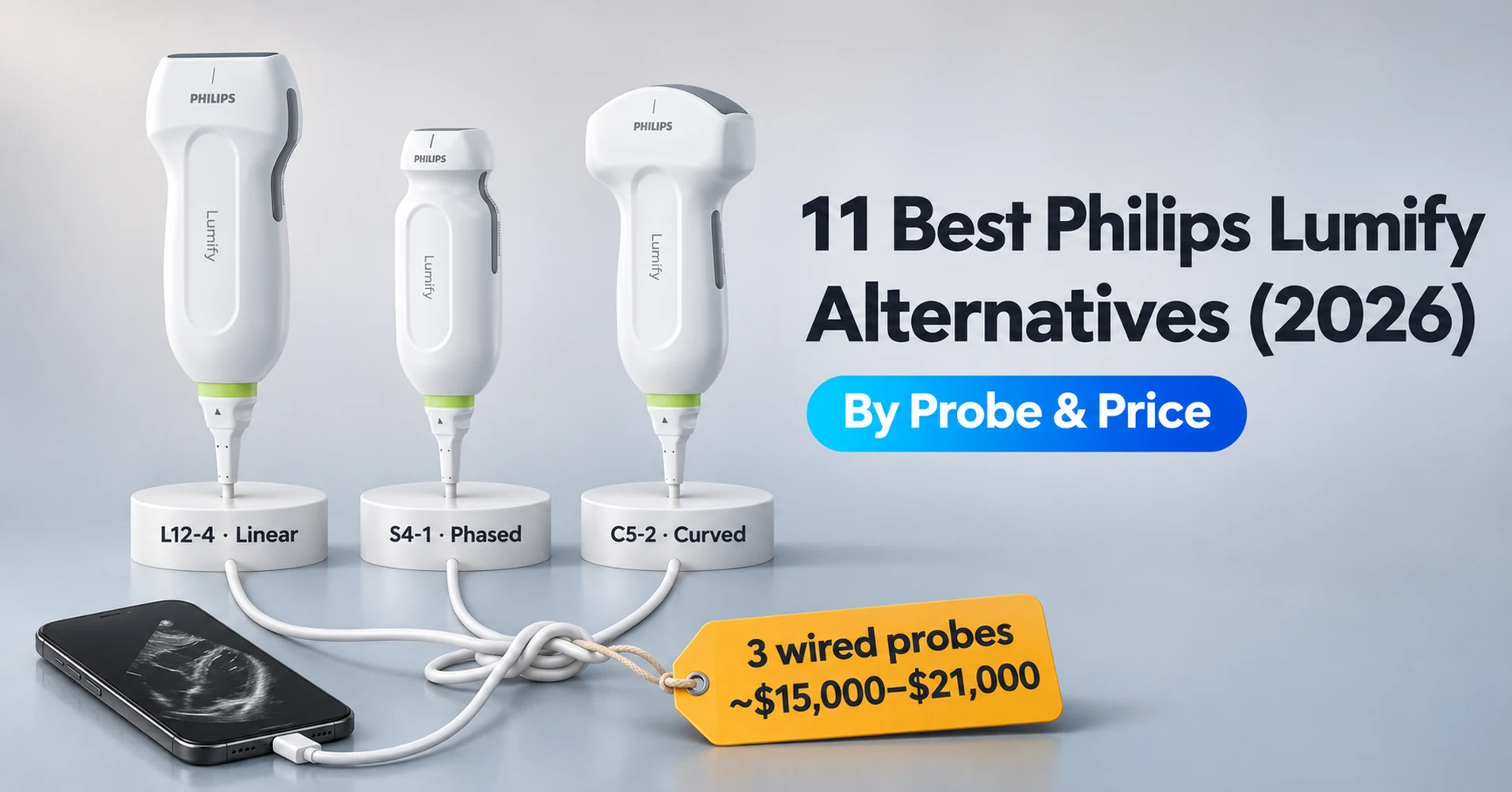
Philips introduced Lumify in 2015 as an app-based ultrasound platform, pairing diagnostic transducers with a mobile-device app. It remains a credible, service-backed system, but the handheld market now offers wireless designs, multi-array probes, deeper software packages, and lower total ownership costs.
This guide compares the obvious specifications—frequency, depth, modes, and probe type—with details buyers can miss, including cables, device compatibility, storage, subscriptions, workflow tools, and realistic purchase cost.
Quick Picks at a Glance: Best Philips Lumify Alternatives by Probe (2026)
| Lumify Probe / Setup | Best No-Subscription Pick | Best Enterprise / Ecosystem Pick | Core Decision Trade-Off |
|---|---|---|---|
| All 3 Lumify Probes (Whole-Body) | TodoPocus™ D3-Ultra ($3,470–$3,570, $0/yr) | Butterfly iQ3 ($3,899 + mandatory plan) or Clarius PAL HD3 ($5,395 + plan) | D3-Ultra gives true wireless 3-in-1 arrays with zero recurring fees; Butterfly excels in cloud/AI fleet tools |
| Lumify L12-4 (Linear: Vascular & MSK) | TodoPocus™ L10H-Guide ($2,870) or L14 Pro ($3,350) — $0/yr | Clarius L15 HD3 ($3,795 + $695/yr Essentials) | L10H-Guide wins on needle navigation & 5 h battery; Clarius adds 15 MHz elastography/AI behind a plan |
| Lumify S4-1 (Phased: Cardiac & FAST) | TodoPocus™ PD2 ($1,899, CW — $0/yr; or CD2 $2,350 w/ linear) | GE Vscan Air SL ($4,999) or Mindray TE Air i3P ($6,699) | PD2 adds CW Doppler & cuts cost by 60%+; GE adds optional Caption AI, Mindray pairs with TE X hospital carts |
| Lumify C5-2 (Curved: Abdomen & OB) | TodoPocus™ C5SH ($2,570, $0/yr) | GE Vscan Air CL ($4,999) or Clarius C3 HD3 ($3,795 + plan) | C5SH includes full OB biometry & DICOM upfront; Vscan Air CL adds a linear side, Clarius scans to 40 cm |
Indice dei contenuti
Philips Lumify at a Glance: Why Do Clinicians Look for Philips Lumify Alternatives?
Lumify earns attention for familiar Philips image processing, lightweight battery-free probes, and an established support network. Its three physical probes share the same basic model. You buy the transducer outright, connect it to a compatible device, and use the included Lumify software without a mandatory subscription.

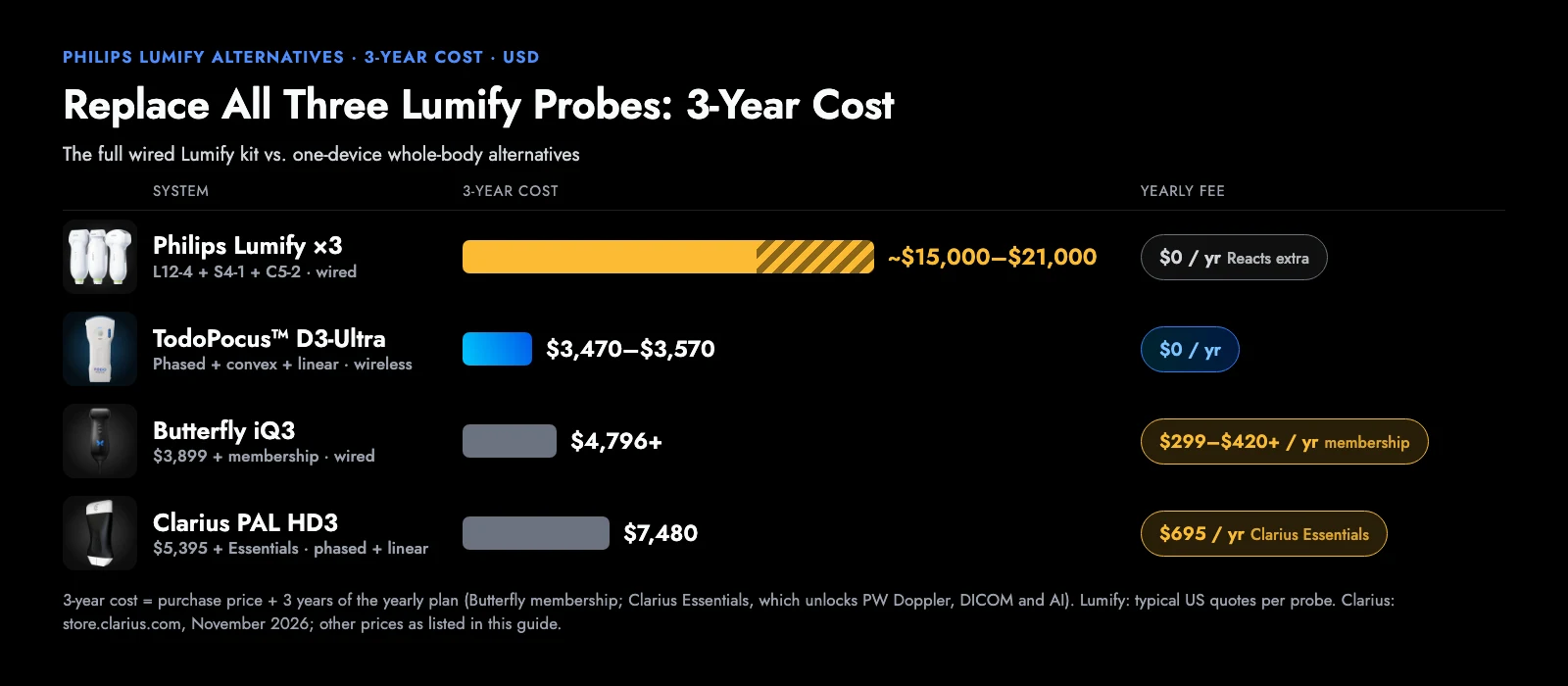
The trade-off is architectural. Lumify is handheld, but it is not wireless. The probe draws power from the phone or tablet through a detachable cable. Android is the native platform—even on newer USB-C iPhone 15/16 or iPad Pro models, Apple configurations still require an external Lumify Power Module and mounting hardware (Philips has also issued compatibility notices regarding reverse trickle-charging on iOS 18+ devices interrupting live scans), and Philips Reacts remote tele-ultrasound collaboration does not support iOS. Then there is the cost and logistics of purchasing, carrying, cleaning, and switching among three separate transducers if you want whole-body imaging: assembling the full L12-4, S4-1, and C5-2 trio runs roughly $15,000–$21,000, compared with wireless all-in-one handheld options below starting at $3,470.
| Lumify Probe | What It Is | Best Suited To | Typical US Price |
|---|---|---|---|
| Philips Lumify L12-4 | 4–12 MHz linear array; up to 12 cm | Vascular, MSK, lung, soft tissue, superficial imaging | ~$5,000–$7,000 |
| Philips Lumify S4-1 | 1–4 MHz phased array; up to 30 cm | Focused cardiac, FAST, lung, abdomen, OB/GYN | ~$5,000–$7,000 |
| Philips Lumify C5-2 | 2–5 MHz curved array; up to 30 cm | Abdomen, gallbladder, lung, transabdominal OB/GYN | ~$5,000–$7,000 |
Best Platforms for Replacing Multiple Lumify Probes With One
3-Probe Lumify Bundle Baseline: Total Cost: ~$15,000–$21,000 | Abbonamento: $0/yr (Reacts extra) | Compatibilità: Wired (3 separate probes + iOS Power Module) | Main Trade-Off: High capital cost & swapping/cleaning 3 wired transducers between exams.
Before matching each individual Lumify transducer to a 1:1 single-probe rival below, start with the bigger workflow question: do you actually want one handheld scanner that replaces the entire Lumify lineup? If you’re outfitting a mixed-use practice, emergency department, hospitalist service, or mobile clinic, buying (and carrying, cleaning, and switching) three separate wired probes rarely makes financial or operational sense.
Several manufacturers now offer multi-array or whole-body probes designed to cover nearly all bedside POCUS applications from one physical device. Below are the three leading platforms consolidating multiple Lumify workflows—followed by dedicated probe-by-probe replacements for the L12-4, S4-1, and C5-2.
1. TodoPocus™ D3-Ultra – Overall Best Alternative to Replace All Philips Lumify Probes With One Handheld Machine
Prezzo: $3,470–$3,570 | Abbonamento: $0/yr (lifetime software, all Doppler & DICOM included) | Compatibilità: Wireless (iOS, Android, Windows)
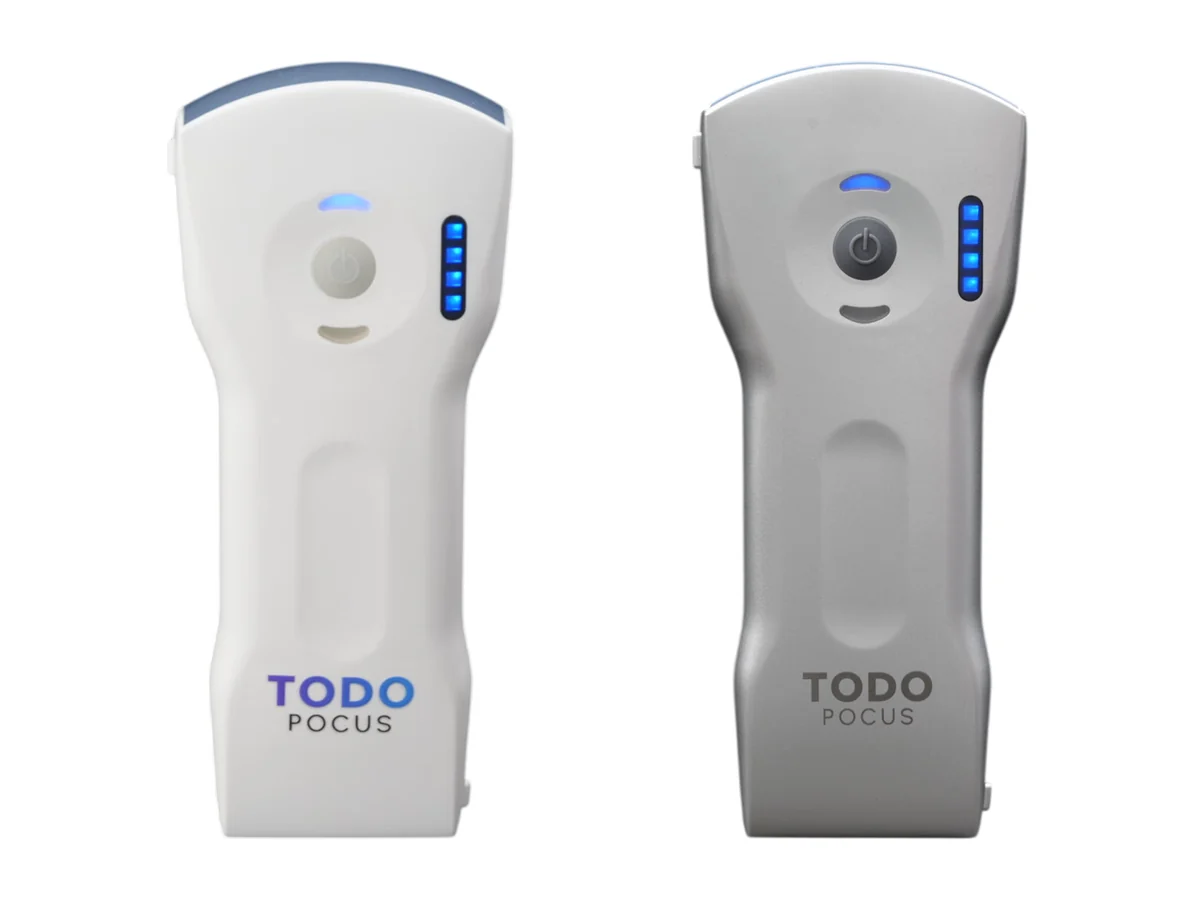
D3-Ultra is a wireless dual-headed scanner. One face houses a combined convex/phased array, while the other houses a dedicated linear array, so it covers a wide clinical territory, approximately 2–10 cm linear and 9–30 cm deep-imaging ranges, in a single unit connecting over Wi-Fi to your phone, tablet, or Windows PC.
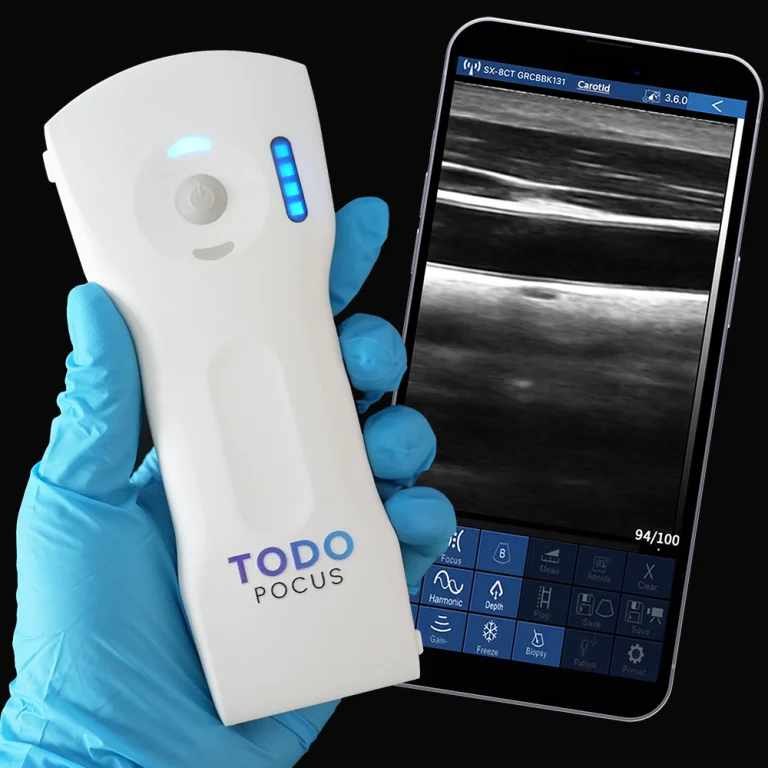
Why it stands out
- Clinical coverage: vascular access, MSK, small parts, lung, focused cardiac, FAST, abdominal, renal, bladder, and transabdominal OB/GYN workflows in one unit.
- Imaging and measurements: B, M, color, power, and PW Doppler; 192 elements, 64 channels, harmonic imaging, 8-step TGC, 15+ presets, body markers, and cardiac/vascular/OB measurements.
- Procedure: in-plane and out-of-plane puncture assistance supports vascular access, blocks, aspirations, and selected guided interventions.
- Data ownership: studies save to the connected iOS, Android, or Windows device, with standard file export and DICOM-to-PACS support; no mandatory cloud.
- Costo: $3,470–$3,570 depending on housing ($3,470 Clinical White / $3,570 Space Silver), with lifetime software access, a three-year standard warranty, and no recurring feature fee.
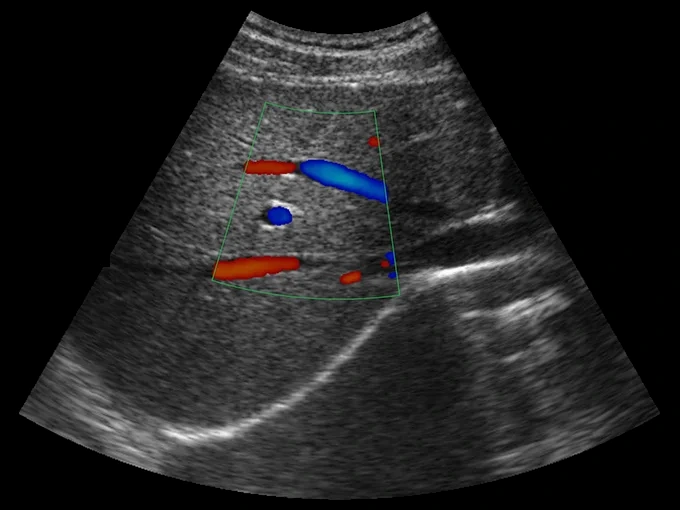
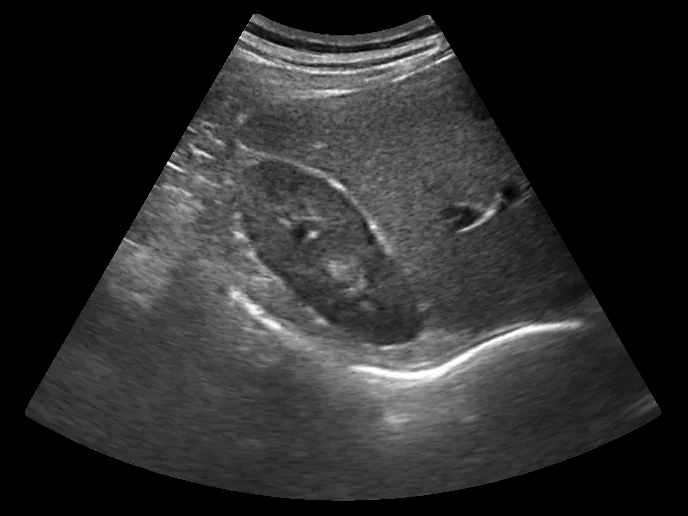
TodoPocus™ D3-Ultra — Replace All 3 Lumify Probes in One Wireless Scanner
$3,470 (bianco clinico) / $3,570 (argento spaziale) | ✓ Phased + Convex + Linear (192 Elements) | ✓ $0 Annual Subscription | ✓ 3-Year Warranty & Free Global Shipping
Explore TodoPocus™ D3-Ultra →2. Butterfly iQ3 – Good Alternative but Expensive Long-Term, Highly Ecosystem-Dependent
Prezzo: $3,899 | Abbonamento: Mandatory $299–$420+/yr membership (enterprise DICOM extra) | Compatibilità: Wired cable (iOS, Android; select tools iOS-only)
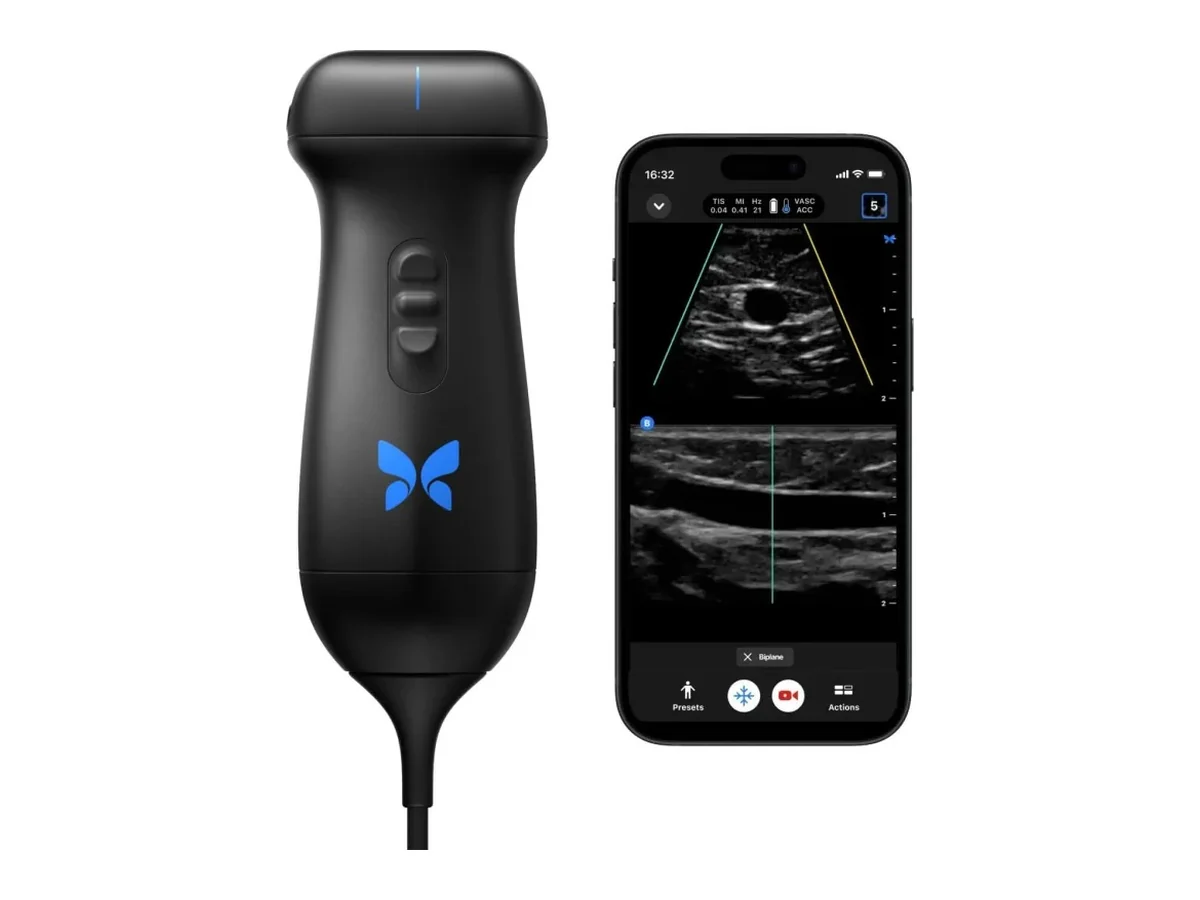
Butterfly iQ3 uses Ultrasound-on-Chip technology rather than three conventional arrays, covering roughly 1–12 MHz through a single cable-connected probe. Its strength is the software environment: whole-body presets, B/M/color/power/PW modes, Needle Viz, Biplane Imaging, iQ Slice, iQ Fan, bladder and B-line automation, education, and cloud documentation.
- Sensible choice for programs standardizing acquisition, governance, and training across multiple users.
- A membership is required for use, feature access varies by tier and operating system, and DICOM or enterprise connectivity may require additional configuration or spend. Less attractive for buyers who want predictable long-term costs.
Want a deeper look at Butterfly’s chip-based platform? Read our complete Butterfly iQ3 review, or see our head-to-head comparison of TodoPocus D3-Ultra vs. Vscan Air CL vs. Butterfly iQ3.
3. Clarius PAL HD3 – Not a Full Replacement but a Good Option
Prezzo: $5,395 | Abbonamento: Optional $695/yr (or $2,500 one-time) Essentials for PW Doppler, DICOM & AI | Compatibilità: Wireless (iOS, Android)
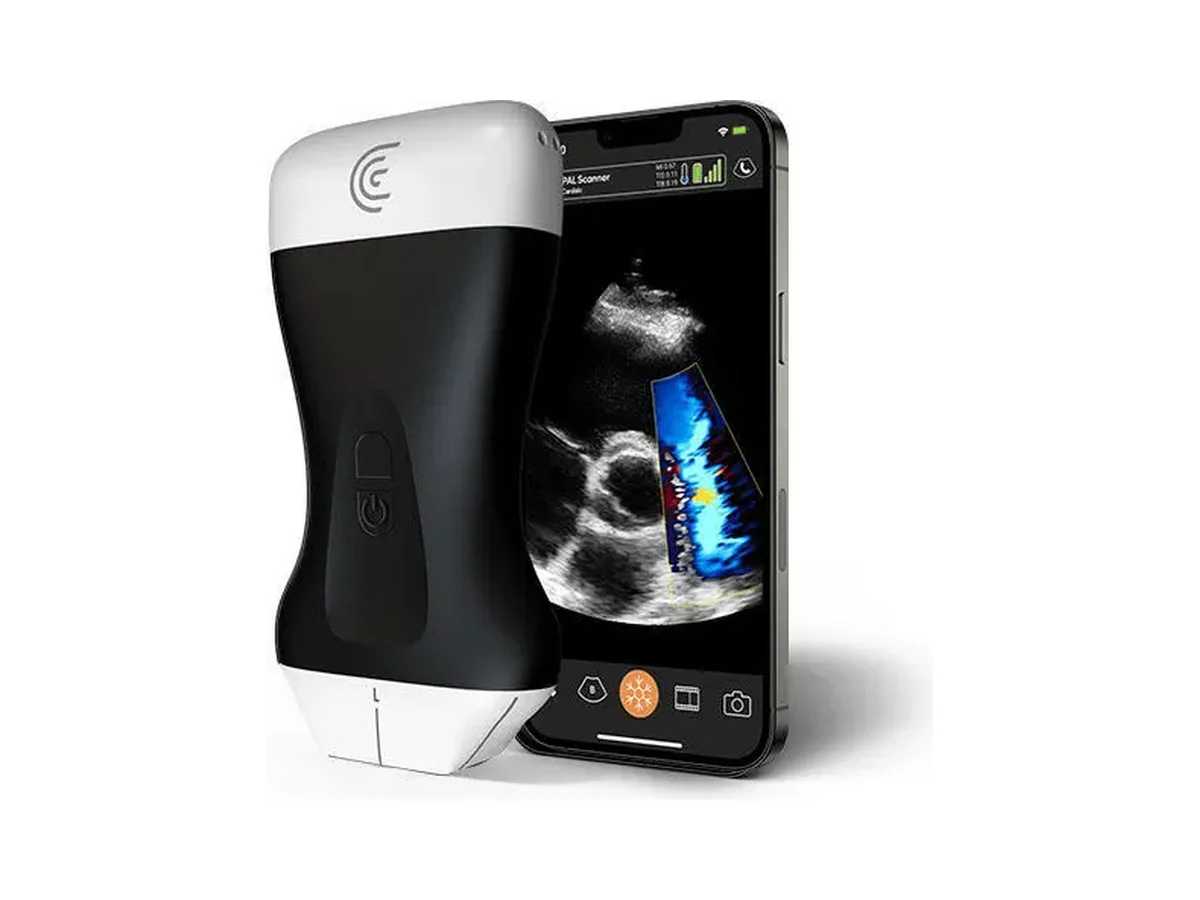
PAL HD3 combines 1–5 MHz phased and 5–15 MHz linear arrays in one wireless body, reaching up to 40 cm on the phased side and about 7 cm on the linear side. That is an excellent pairing for cardiac, lung, eFAST, vascular access, nerve, MSK, and small-parts work (see how it stacks up against semiconductor probes in our Clarius PAL HD3 vs. Butterfly iQ3 comparison). It can also perform selected abdominal imaging through the phased array, but it is not a complete mechanical replacement for a broad-footprint convex probe in routine abdominal or obstetric workflows.
- It is not a true convex replacement. Also account for its 307 g weight and roughly 60-minute battery life.
- Core imaging works without membership; Essentials adds PW Doppler, cloud, AI, voice controls, specialty software, education, and team tools.
Quick Comparison: Handheld Ultrasounds Replacing Philips Lumify Line for Full Body Imaging
| Specifiche | TodoPocus™ D3-Ultra | Butterfly iQ3 | Clarius PAL HD3 |
|---|---|---|---|
| Physical probe | Wireless dual head: linear + convex/phased | Wired single semiconductor whole-body probe | Wireless phased + linear |
| Frequenza e profondità | Linear 7.5/10; convex/phased 3.2/5.0 MHz; 2–30 cm | Approx. 1–12 MHz; preset-dependent | 1–15 MHz overall; phased up to 40 cm, linear up to 7 cm |
| Notable features | Full body coverage; 192 elements/64 channels; full Doppler; DICOM | AI guidance; Biplane; Needle Viz; unified cloud/fleet workflow | Deep and superficial imaging; optional AI/cloud/voice/PW |
| Battery and charge time | 2+ h battery; 2800 mAh; wireless charge |
2 hr battery; contact charger |
About 60 min scan; ricarica wireless |
| Size and weight | 156 × 65 × 20 mm; about 263 g | 185 × 56 × 35 mm; about 300 g | 148 × 76 × 32 mm; 307 g |
| Compatibilità | iOS, Android e Windows | iOS and Android; some tools are iOS-only | iOS e Android |
| Archiviazione | Local; image/video export and DICOM/PACS | Butterfly Cloud; DICOM/enterprise integration depends on package | Local, cloud and DICOM listed with Membership |
| Abbonamento | Assente | Membership required for initial use/full features and storage access | Optional Essentials |
| Est. price USD with warranty | $3,470–$3,570; Garanzia standard di 3 anni |
$3,899 + membership; enterprise/DICOM may add cost; garanzia di 3 anni |
$5,395 + $695/year or $2,500 One-Time Essentials; Garanzia standard di 3 anni |
Best Philips Lumify L12-4 Alternatives
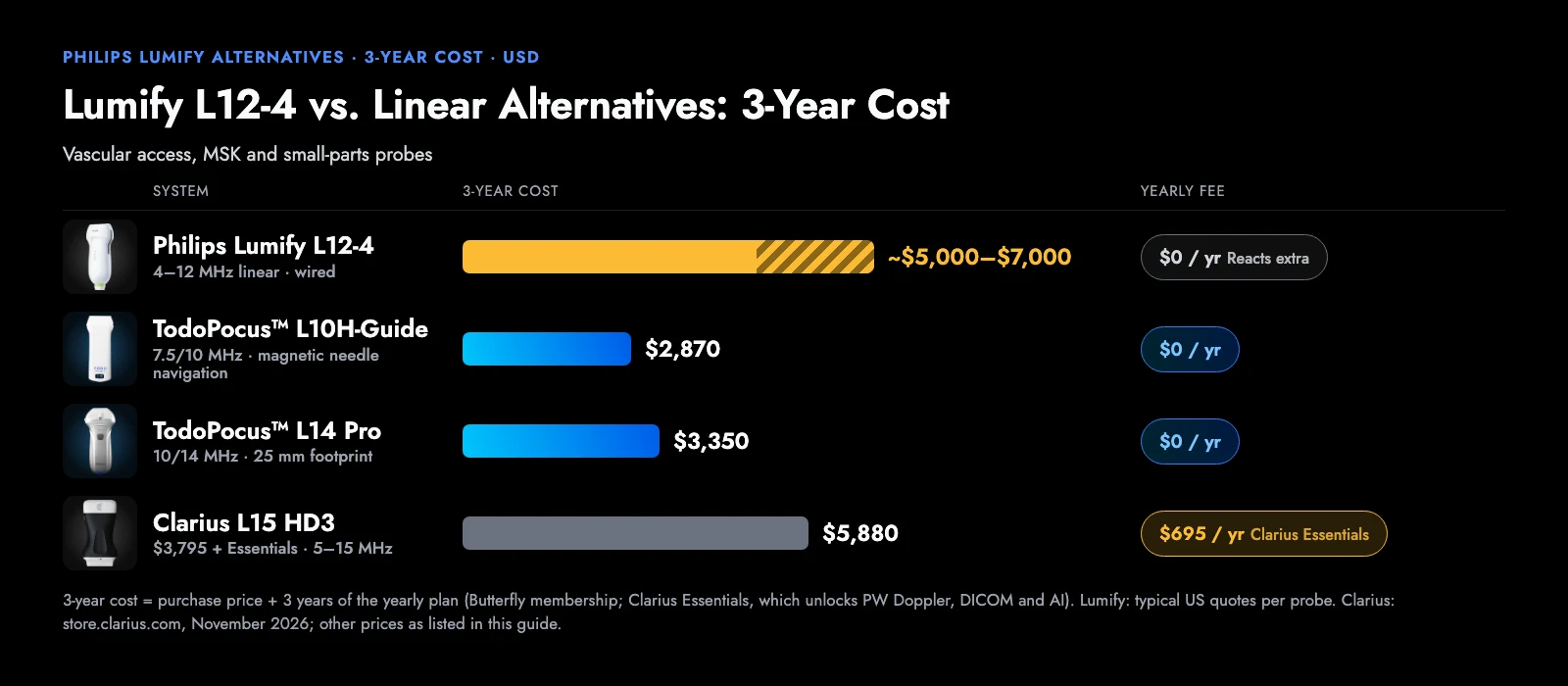
Philips Lumify L12-4 Baseline: Prezzo: ~$5,000–$7,000 | Abbonamento: $0/yr (Reacts tele-ultrasound extra) | Compatibilità: Wired USB-C (Android native; iOS requires Power Module) | Main Trade-Off: Cable-tethered during sterile procedures; no magnetic needle navigation.
If your practice only needs a dedicated single-array replacement rather than a full-body scanner, we break down each Lumify transducer individually below—starting with the linear probe. The Philips Lumify L12-4 is a 4–12 MHz linear probe designed for vascular, MSK, lung, soft-tissue, and other superficial exams (for a direct single-model matchup, see our Lumify L12-4 vs. TodoPocus D3-Ultra comparison).
A useful replacement among today’s best linear ultrasound machines, therefore, needs more than a similar frequency label. We also considered footprint, depth, Doppler access, needle visualization (since linear probes are the ones most often used for vascular access and injections), battery independence, and whether advanced functions require a recurring plan.
1. TodoPocus™ L10H-Guide – Best Philips Lumify L12-4 Alternative for Vascular Access
Prezzo: $2,870 | Abbonamento: $0/yr (All Doppler, Visualized Needle Guidance & DICOM included) | Compatibilità: Wireless Wi-Fi & USB Wired (iOS, Android, Windows)
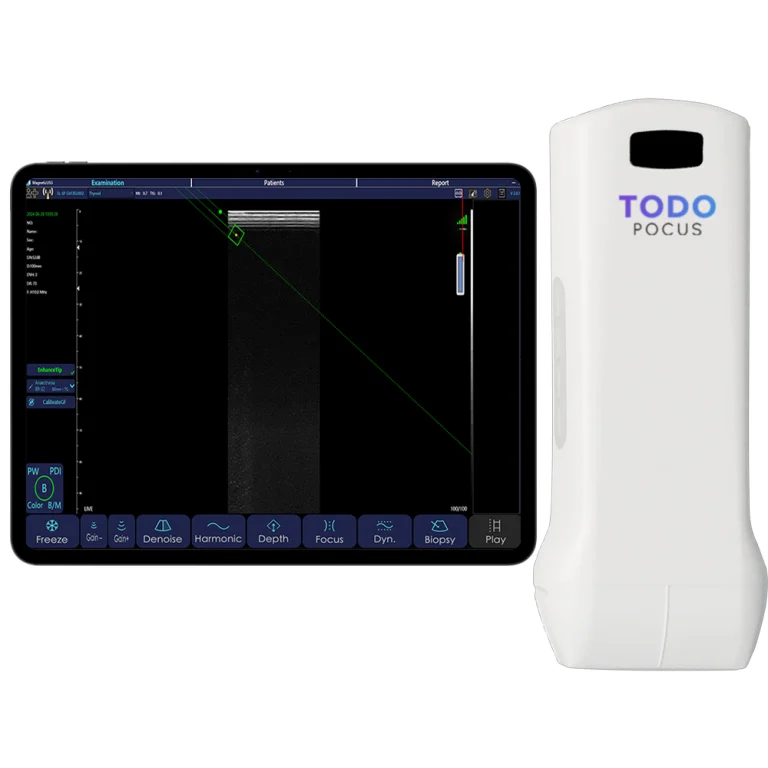
If your linear probe is used as much for procedures as for diagnosis, the L10H-Guide is the clearest workflow upgrade. Its 7.5/10 MHz, 192-element linear array covers 20–100 mm, while magnetic navigation displays the expected needle trajectory for in-plane and out-of-plane approaches.
That combination is particularly useful for difficult IV access, nerve blocks, aspirations, and selected biopsies. The trade-off is a lower top frequency than the L12-4, so if you prioritize the finest superficial MSK detail, also consider the L14 Pro or Clarius L15.
- Five-hour continuous scanning with wireless Wi-Fi or USB wired connection suits procedure-heavy lists.
- Color, power, and PW Doppler, DICOM export, local storage, and software updates are included without a subscription.
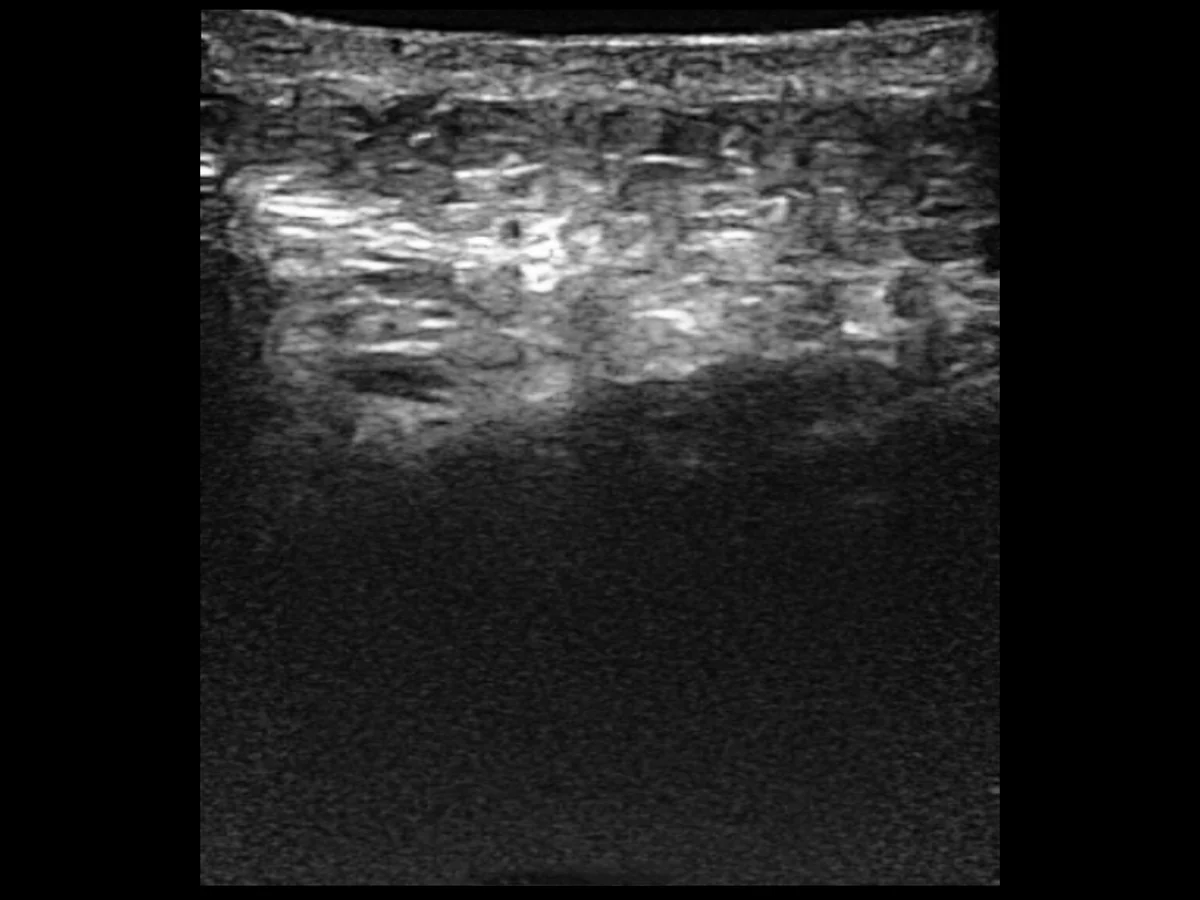
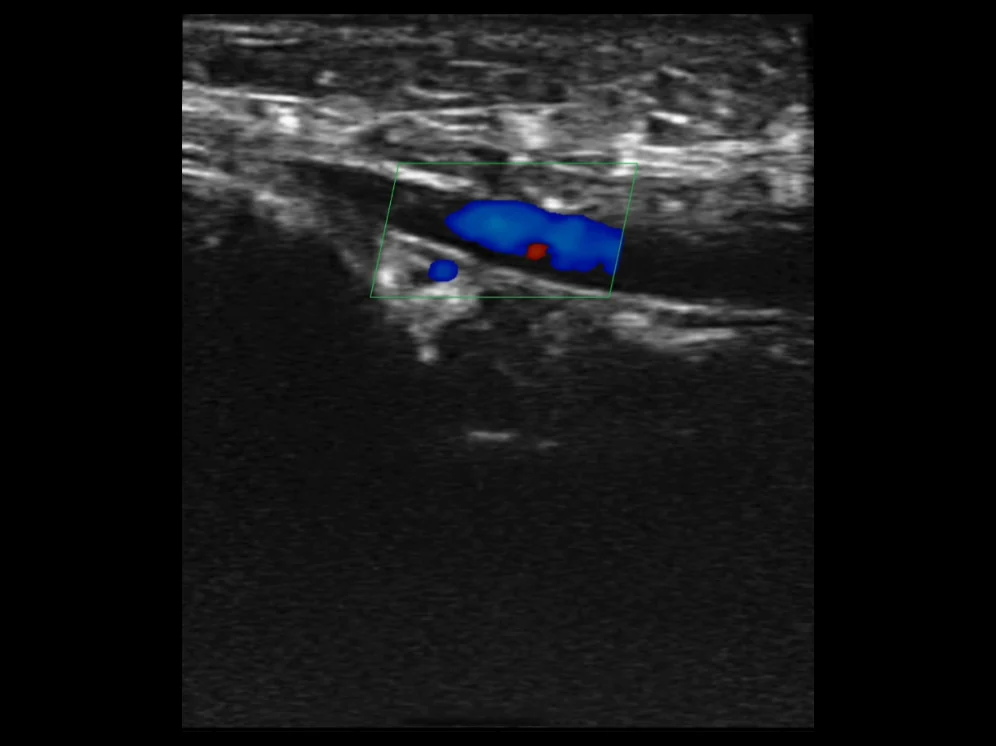
2. TodoPocus™ L14 Pro – Best Philips Lumify L12-4 Alternative for High-Resolution MSK and Small Parts
Prezzo: $3,350 | Abbonamento: $0/yr (all Doppler & DICOM included) | Compatibilità: Wireless (iOS, Android, Windows)
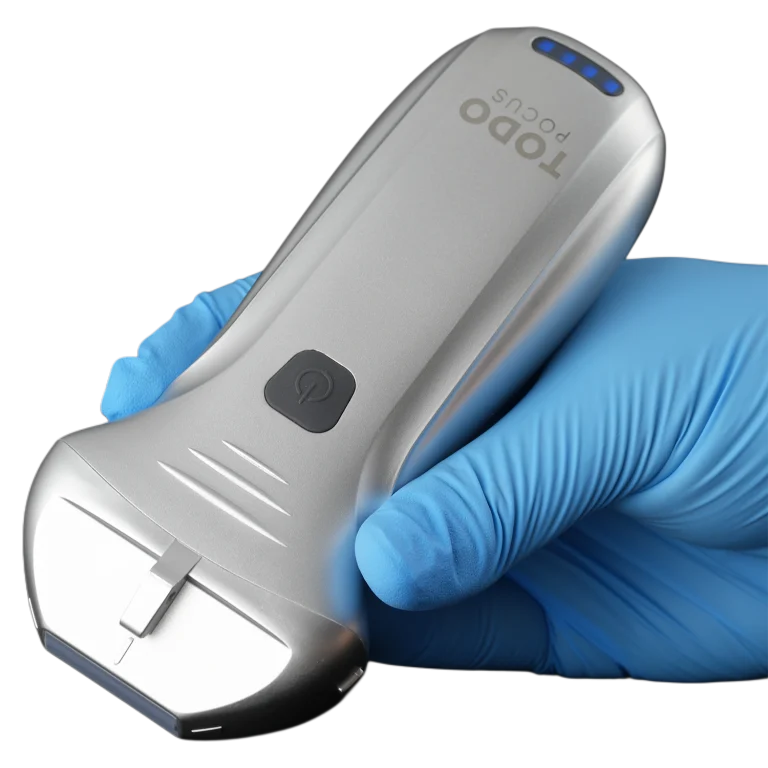
The L14 Pro trades some depth for a smaller footprint (25 mm) and a higher 10/14 MHz frequency band, a combination that makes it noticeably better suited to imaging tendons, ligaments, small joints, nerves, thyroid, pediatric small parts, and neonatal superficial work. A 192-element, 64-channel architecture supports cleaner processing, while color, power, and PW Doppler remain available without a plan.
- Purpose-built for small parts and pediatric anatomy.
- In-plane and out-of-plane puncture assist plus a 1,000-frame cine loop for reviewing scans after the fact.
3. Clarius L15 HD3 – Best Philips Lumify L12-4 Alternative for MSK and Procedural Specialists
Prezzo: $3,795 | Abbonamento: Optional $695/yr (or $2,500 one-time) Essentials for PW Doppler, elastography & DICOM | Compatibilità: Wireless (iOS, Android)
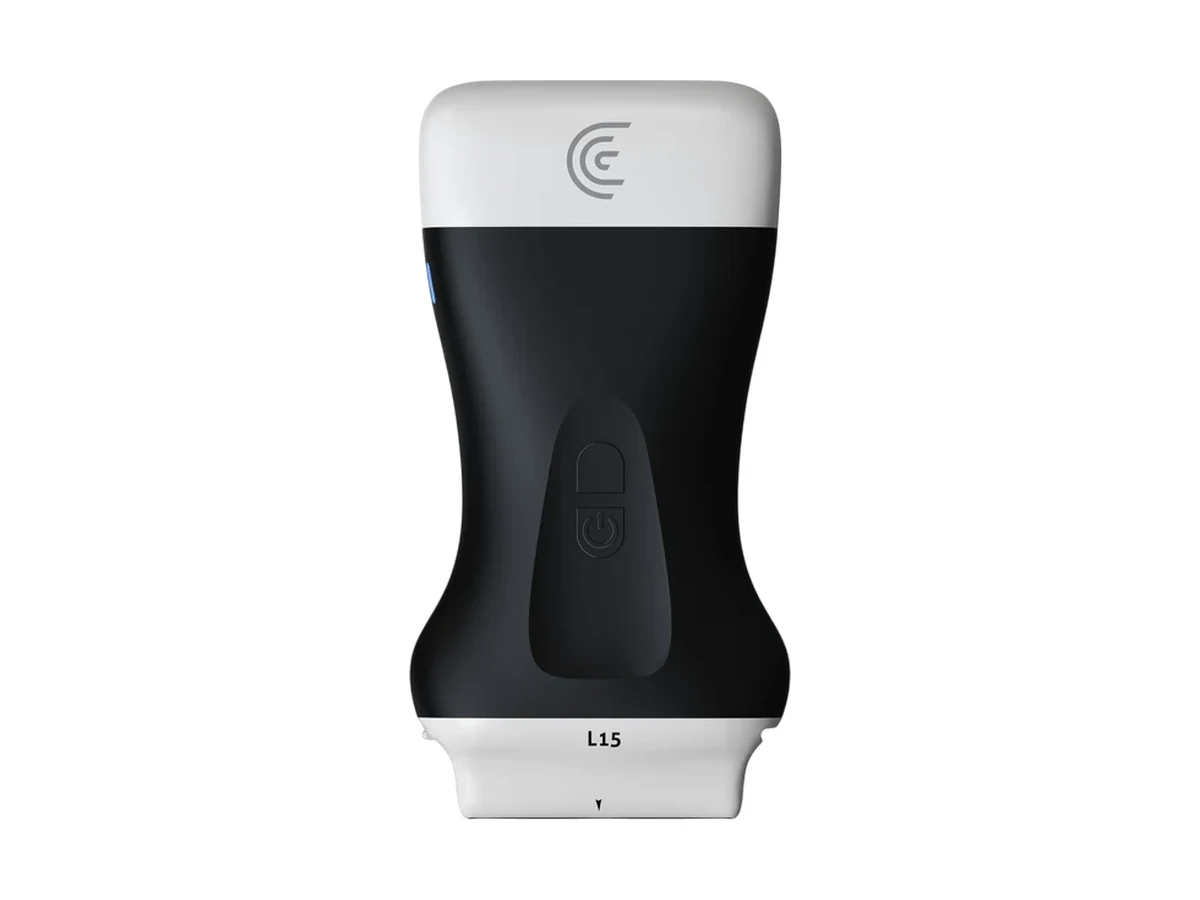
If your practice leans heavily into sports medicine, orthopedics, or pain management, the L15 HD3 is purpose-built for that lane, with dedicated presets for nearly every joint (shoulder, knee, elbow, hip, foot/ankle) plus nerve/pain and plastic surgery presets baked in.
Where it pulls ahead of the L12-4 is its optional elastography and Needle Enhance tools, genuinely useful if you’re doing a lot of guided injections, though those live behind a membership tier, so factor that into your cost comparison rather than assuming the base price is the full story.
- Membership unlocks Needle Enhance, elastography, Split Mode, and Pulsed Wave Doppler for procedural work.
- At 290 g and around one hour of battery operation, it is less economical and less endurance-focused than the TodoPocus™ options.
Quick Comparison: L12-4 vs. Alternatives
| Specifiche | Philips Lumify L12-4 | TodoPocus™ L10H-Guide | TodoPocus™ L14 Pro | Clarius L15 HD3 |
|---|---|---|---|---|
| Physical probe | Wired linear | Wireless & USB linear | Wireless linear | Wireless linear |
| Frequenza e profondità | 4–12 MHz; up to 12 cm | 7.5/10 MHz; 2–10 cm | 10/14 MHz; 2–6 cm | 5–15 MHz; up to 7 cm |
| Notable features | Color/PW, M-mode, XRES, harmonics, SonoCT; DICOM | Magnetic needle navigation; 192 elements; full Doppler; DICOM | 25 mm footprint; 192 elements/64 channels; full Doppler; long cine | MSK presets; elastography, AI, cloud, PW and voice tools with package |
| Battery and charge time | No probe battery; powered by host device; up to 7.5 h system use | 5 h continuous; 5600 mAh; USB charge | 3 h continuous; 4400 mAh; USB/wireless charge | About 60 min scan; Wireless/Magnetic socket |
| Size and weight | 102 × 51 mm; 136 g incl. cable | 156 × 60 × 20 mm; 200 g | 156 × 60 × 28 mm; 230 g | 147 × 76 × 32 mm; 290 g |
| Compatibilità | Compatible with Android; iOS via supplied power module/kit | iOS, Android e Windows | iOS, Android e Windows | iOS e Android |
| Archiviazione | Local device, email, network share and DICOM/PACS | Local; JPEG/PNG/MP4 and DICOM export | Local; image/video export and DICOM | Local, cloud and DICOM listed with Membership |
| Abbonamento | No core subscription; Reacts optional | Assente | Assente | Optional Essentials |
| Est. price USD with warranty | $5,000–$7,000; Up to 5-year warranty |
$2,870; 3-year standard warranty, optional 5-year extension |
$3,350; 3-year standard warranty, optional extension |
$3,795 + $695/year or $2,500 One-Time Essentials; Garanzia standard di 3 anni |
Best Alternatives to the Philips Lumify S4-1
Philips Lumify S4-1 Baseline: Prezzo: ~$5,000–$7,000 | Abbonamento: $0/yr (Reacts extra) | Compatibilità: Wired USB-C (Android native; iOS requires Power Module) | Main Trade-Off: No Continuous Wave (CW) Doppler; tethered cable.
Il Philips Lumify S4-1 is a 1–4 MHz phased-array probe for focused cardiac, FAST, lung, abdomen, and selected OB/GYN work to 30 cm. The best alternatives must preserve a small cardiac window and useful Doppler performance, not merely deep penetration.
We also weighed cardiac measurements, TDI or CW availability, vascular crossover, wireless handling, battery runtime, image management, and the cost of unlocking advanced modes.
1. TodoPocus™ PD2 – Best Philips Lumify S4-1 Alternative for Dedicated Cardiac Echo (with CW Doppler)
Prezzo: $1,899 | Abbonamento: $0/yr (CW/PW Doppler & DICOM included) | Compatibilità: Wireless (iOS, Android, Windows)
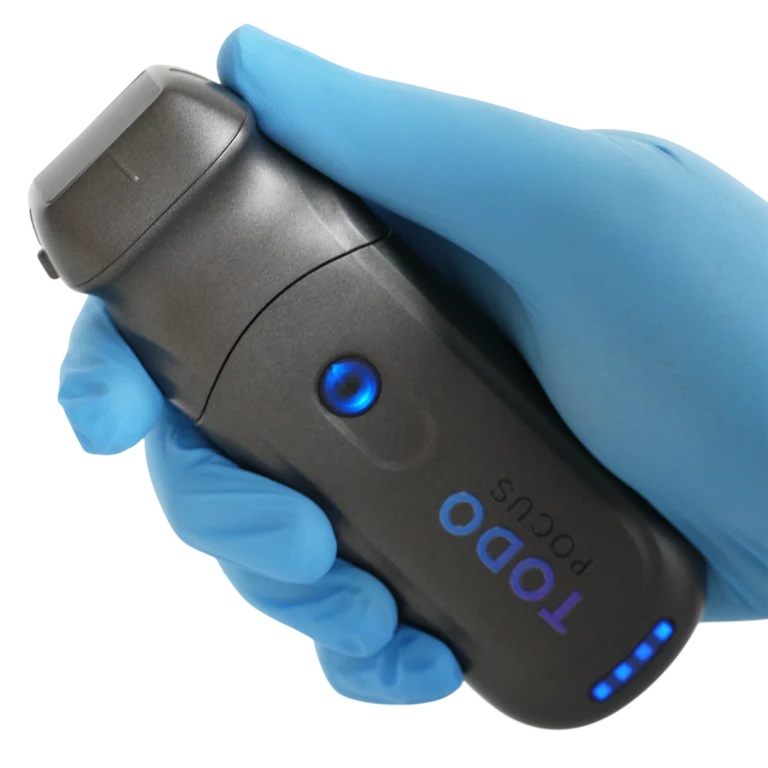
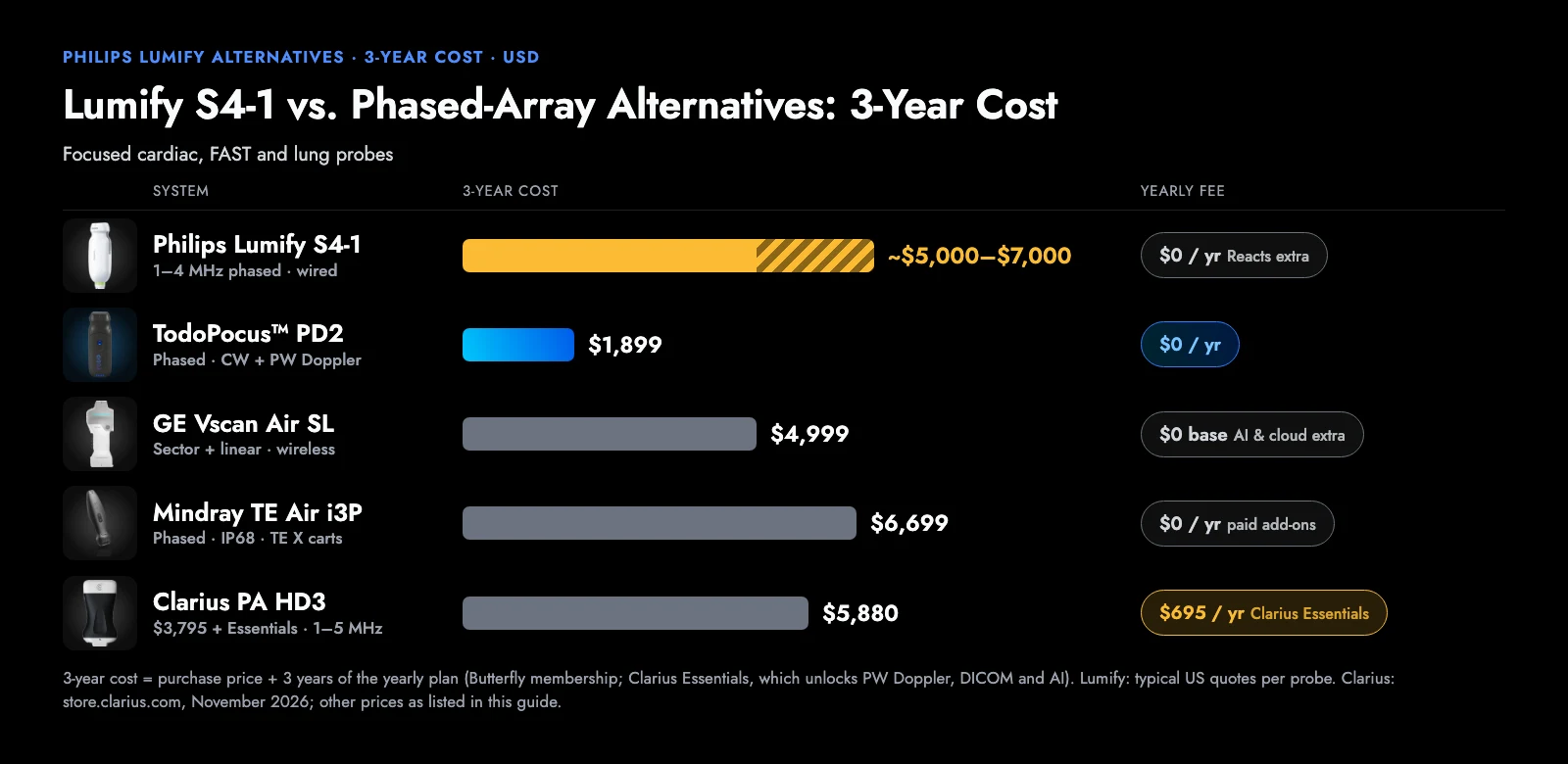
TodoPocus™ PD2 is the closest 1:1 wireless phased-array counterpart to the S4-1, offering three distinct frequency bands (2.2/2.8/3.6 MHz across transcranial, central, and cardiac reverse harmonic settings) tuned specifically for bedside echocardiography. Crucially, it includes Doppler a onda continua (CW) alongside Color, Power, and PW Doppler—a key hemodynamic capability for assessing high-velocity valvular jets that the Lumify S4-1 does not offer at all. If your exams are primarily cardiac (EF, stroke volume, LVIDd/LVIDs), the PD2’s dedicated cardiac tuning, ultra-light 120 g body, 1.5-hour battery, and $1,899 one-time price make it the sharpest value pick in this class.
- Dedicated single-head phased array with Continuous Wave (CW) Doppler, lighter (120 g) and over 60% cheaper than the Lumify S4-1.
- Full cardiac measurement package, local image/video export, and DICOM included with zero annual fees.
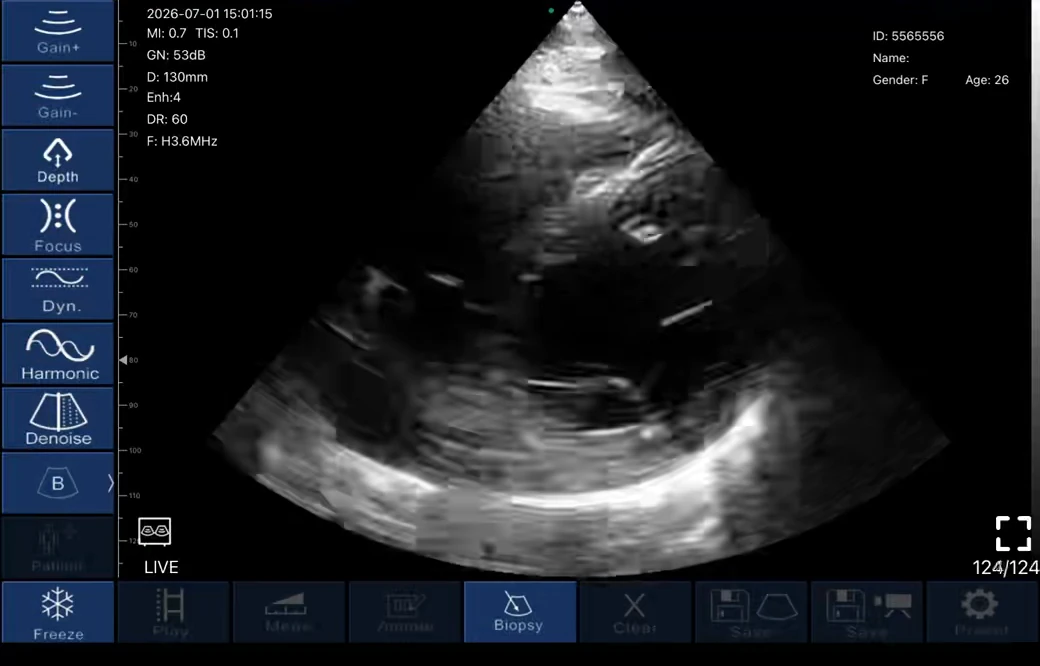
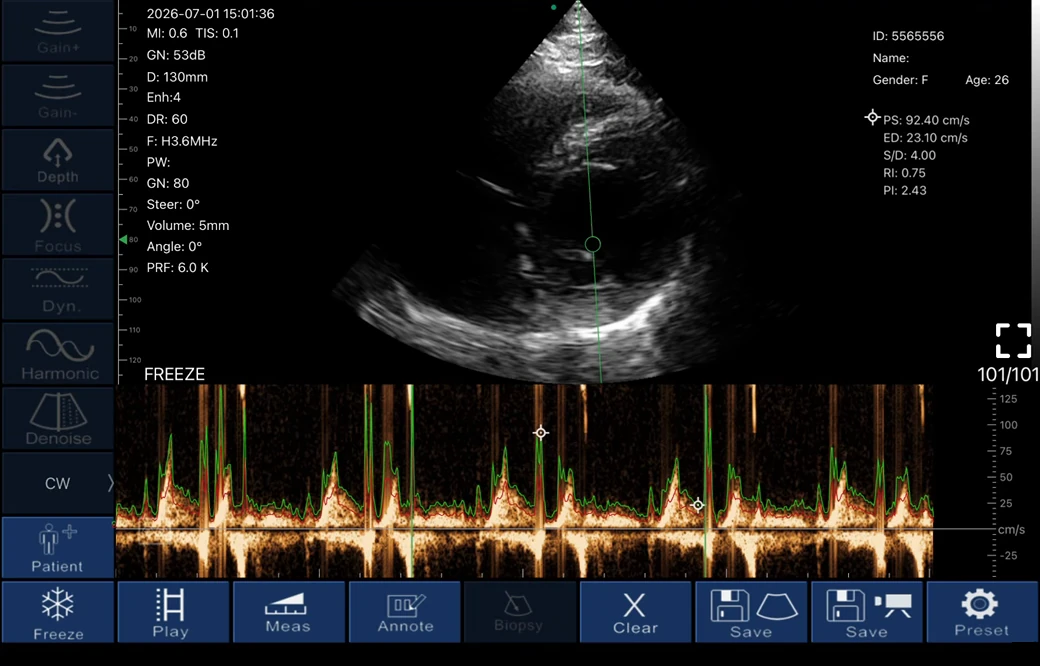
Need linear vascular access alongside cardiac echo—similar to the $4,999 GE Vscan Air SL below? Consider its dual-array sibling, the TodoPocus™ CD2 ($2,350), which pairs phased and linear transducers in one wireless unit (see our Lumify S4-1 vs. Vscan Air SL vs. TodoPocus CD2 breakdown).
2. GE Vscan Air SL – Best Philips Lumify S4-1 Alternative for Rapid Cardiac and Vascular Assessments
Prezzo: $4,999 (base) | Abbonamento: $0/yr core (Caption AI & MyRemoteShare optional) | Compatibilità: Wireless (iOS, Android)
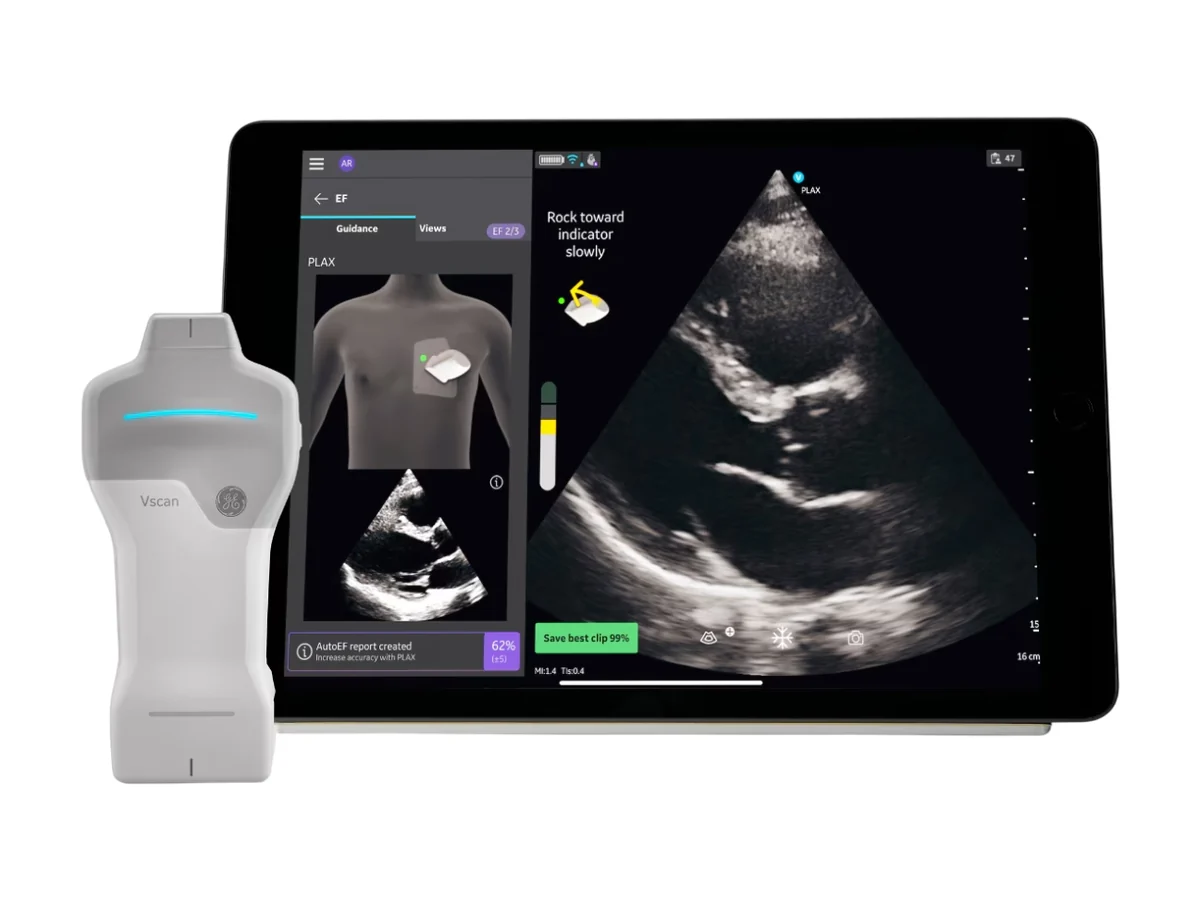
GE built the Vscan Air SL specifically to compete in this exact lane, pairing a sector-phased array with a linear probe in one dual-sided transducer, so, similar to the CD2, you get cardiac and vascular coverage without swapping hardware. Its SignalMax architecture, B/M/color/PW modes, wireless form factor, and GE workflow make it a credible premium choice (if its $4,999 sticker price stretches your budget, see our guide to affordable alternatives to the GE Vscan Air SL).
- Battery endurance is about 50 minutes.
- Caption AI can guide users through standard echo views and calculate LVEF, which may be valuable for training or protocolized acquisition, but it is an optional paid innovation rather than a reason every experienced sonographer should buy the platform.
3. Mindray TE Air i3P – Best Philips Lumify S4-1 Alternative for No-Subscription Cardiac Imaging
Prezzo: $6,699 (base) | Abbonamento: $0/yr recurring (paid add-ons for Auto EF, TDI & Air Capsule) | Compatibilità: Wireless (iOS, Android & Mindray TE X carts)
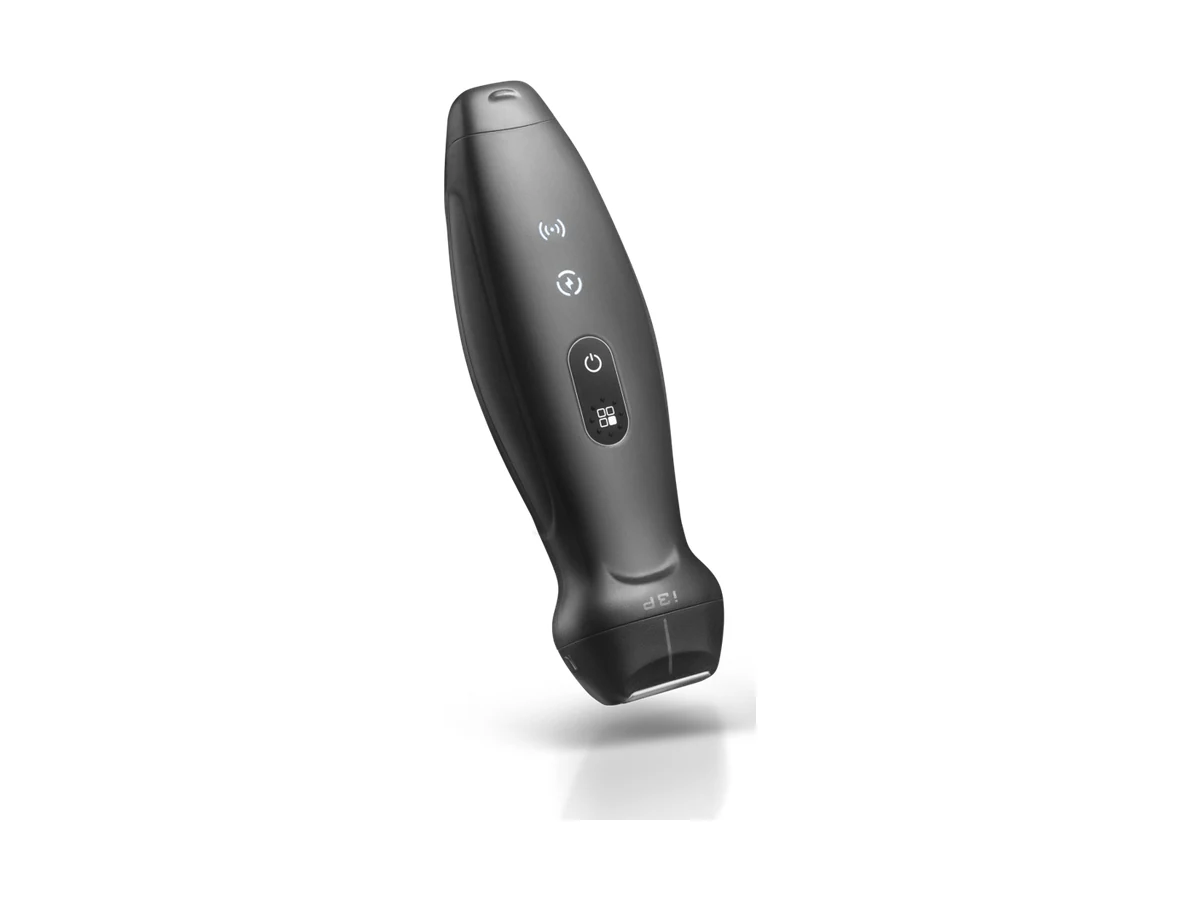
The TE Air i3P is a dedicated wireless phased-array device built for emergency and critical care. It covers cardiac, abdomen, lung, FAST, transcranial, and other focused presets with B, M, color, power, and PW Doppler; TDI and Auto EF may be optional by configuration. Its $6,699 hospital-grade positioning reflects IP68 full-immersion disinfection and dual deployment: it can work standalone with the mobile app or connect as a wireless transducer to compatible Mindray TE X cart systems (explore our full Mindray TE Air review for details).
- Provides fast charging, with over 90 minutes of scanning support.
- Add-on features such as Auto EF, TDI, extended connection, and the Air Capsule can increase the final quote.
4. Clarius PA HD3 – Best Philips Lumify S4-1 Alternative for Critical Care and eFAST
Prezzo: $3,795 | Abbonamento: Optional $695/yr (or $2,500 one-time) Essentials for PW Doppler, cloud & AI | Compatibilità: Wireless (iOS, Android)
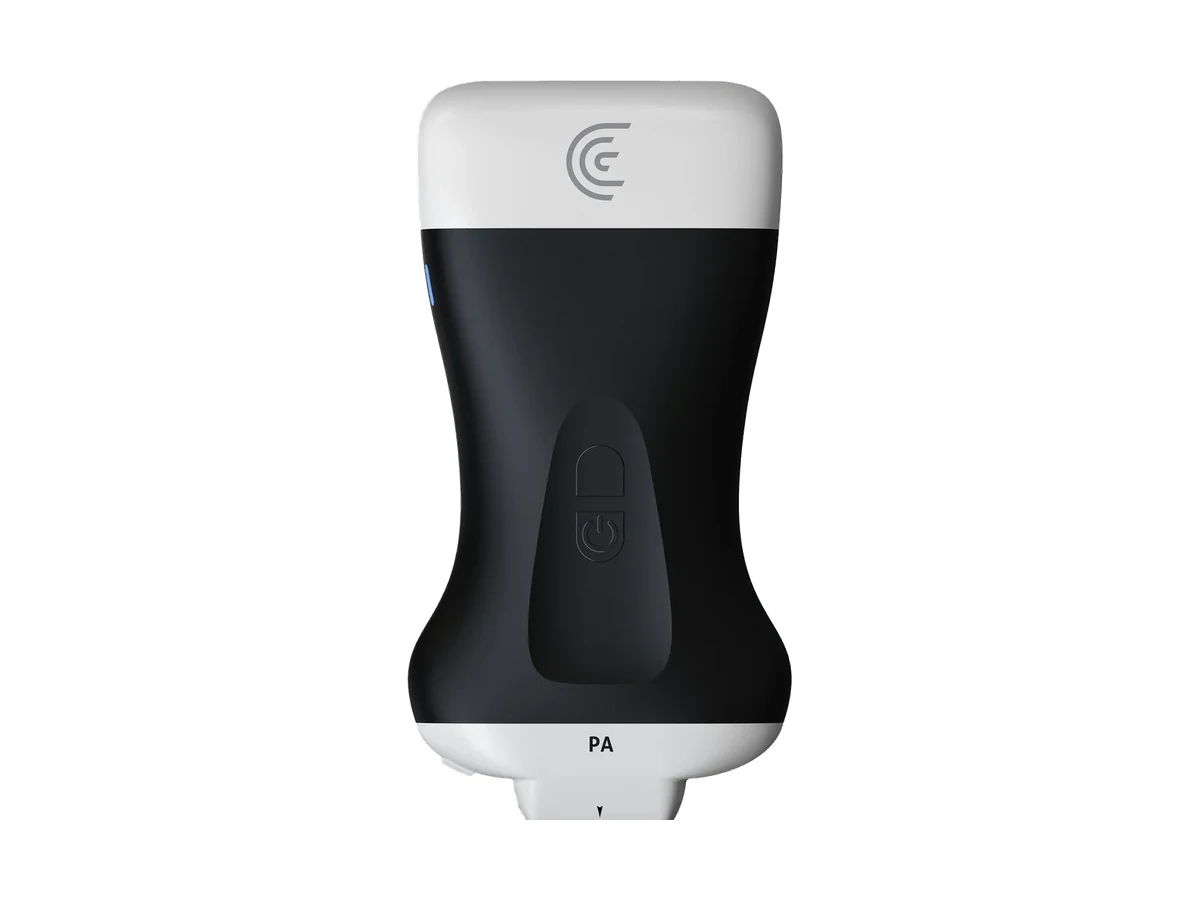
The PA HD3 is Clarius’s dedicated phased array, tuned for the same cardiac/critical-care/eFAST lane as the S4-1, with a 1–5 MHz range that reaches deeper (up to 40 cm) than Lumify’s S4-1. Its potential advantages in emergency care include startup time and presets for Abdomen, Bladder, Cardiac, eFAST, Lung, and Obstetrics all preloaded, and Clarius’s app is widely regarded as one of the more intuitive interfaces in this category.
- Core imaging does not require a membership. PW Doppler, cloud, AI, voice controls, education, and other specialty functions sit within the paid Essentials package.
- Battery life is about an hour, and the scanner is heavier than the S4-1.
Quick Comparison: S4-1 vs. Alternatives
| Specifiche | Philips Lumify S4-1 | TodoPocus™ PD2 | GE Vscan Air SL | Mindray TE Air i3P | Clarius PA HD3 |
|---|---|---|---|---|---|
| Physical probe | Wired phased | Wireless phased | Wireless sector/phased + linear | Wireless phased | Wireless phased |
| Frequenza e profondità | 1–4 MHz; up to 30 cm | 2.2/2.8/3.6 MHz; 9–20 cm | Sector 1.6–3.7; linear 3–12 MHz; up to 24 cm, 8 cm linear |
2–4 MHz; depth/preset dependent | 1–5 MHz; up to 40 cm |
| Notable features | Cardiac/FAST presets; color/PW; M-mode; DICOM | CW + PW Doppler; cardiac measurements; focused echo | Caption AI option; dual array; SignalMax; B/M/color/PW | TDI and Auto EF options; IP68; TE X integration | 90° FOV; deep imaging; optional AI/cloud/PW |
| Battery and charge time | No probe battery; powered by host; up to about 5 h continuous use | 1.5 h; 2200 mAh; USB charge | 50 min; wireless charge | 90–120 min; USB-C or optional Air Capsule | About 60 min; wireless charging |
| Size and weight | 102 × 51 mm; 96 g without cable, under 136 g total | 135 × 40 × 25 mm; 120 g | 141 × 67 × 33 mm; 218 ±3 g | 46.5 × 33 × 170 mm; about 199 g | 148 × 76 × 32 mm; 292 g |
| Compatibilità | Compatible with Android; iOS via supplied power module/kit |
iOS, Android e Windows | iOS e Android | iOS e Android | iOS e Android |
| Archiviazione | Local device, email, network share and DICOM/PACS | Local; image/video export and DICOM | Local device; DICOM and optional MyImageCloud/Digital Tools | Local JPG/MP4; DICOM, Worklist and supported third-party/cloud routes | Local, cloud and DICOM listed with Membership |
| Abbonamento | No core subscription; Reacts optional | Assente | Core scanning: no; digital/AI tools optional | No recurring core plan | Optional Essentials |
| Est. price USD with warranty | $5,000–$7,000; up to 5-year warranty |
$1,899; Garanzia standard di 3 anni |
$4,999 base, options extra; Garanzia standard di 3 anni |
$6,699 base; 3-year transducer warranty |
$3,795 + $695/year or $2,500 One-Time Essentials; Garanzia standard di 3 anni |
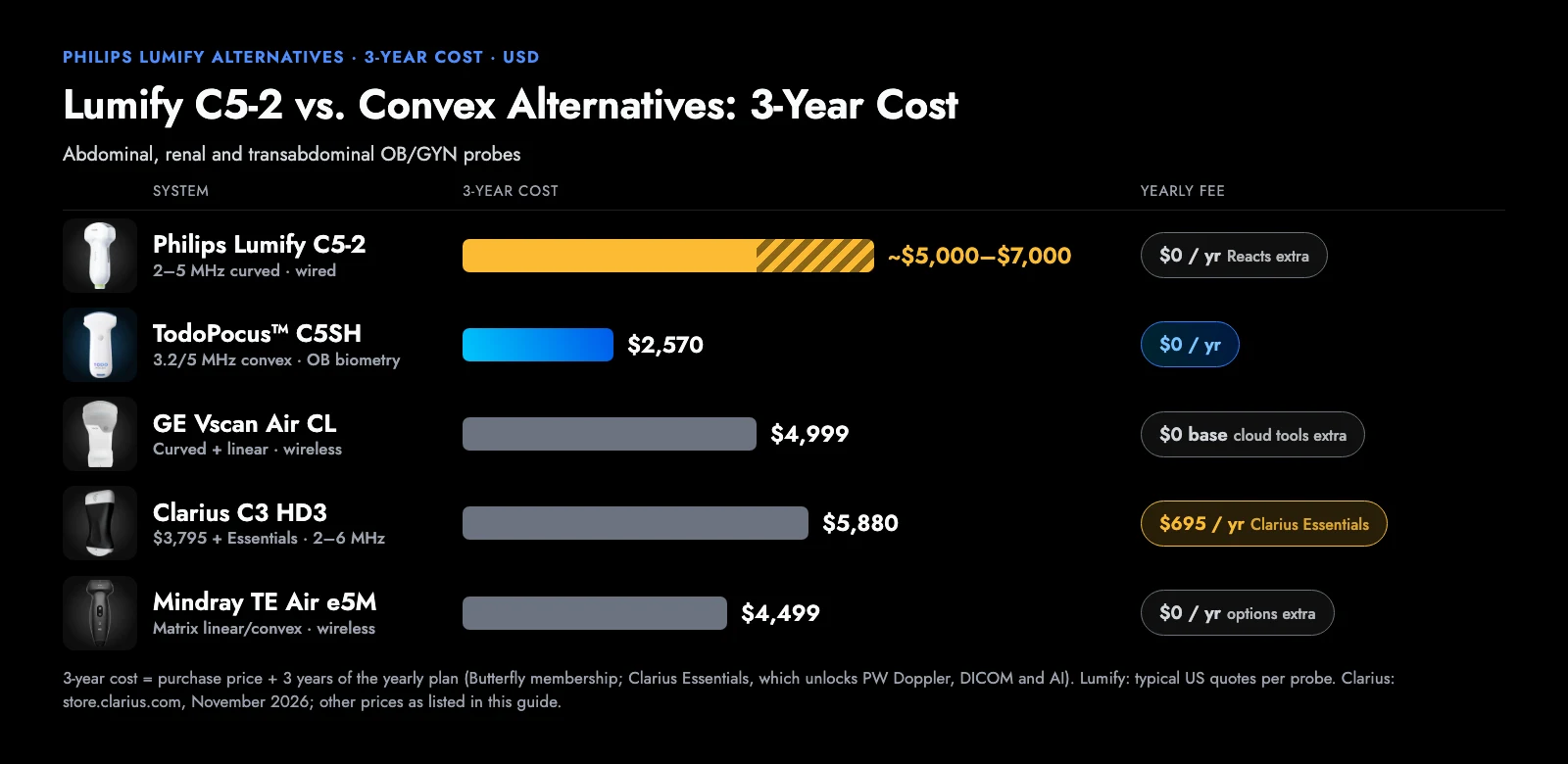
Best Alternatives to the Philips Lumify C5-2
Philips Lumify C5-2 Baseline: Prezzo: ~$5,000–$7,000 | Abbonamento: $0/yr (Reacts extra) | Compatibilità: Wired USB-C (Android native; iOS requires Power Module) | Main Trade-Off: Wired single-array only; requires extra probes for vascular or cardiac exams.
Il Philips Lumify C5-2 is a 2–5 MHz curved probe for abdomen, gallbladder, lung, and transabdominal OB/GYN imaging to 30 cm. Suitable alternatives need a broad deep field, appropriate abdominal and obstetric presets, Doppler and measurement support, and practical archiving.
We also considered whether a device adds linear capability, procedural tools, smart measurements, or a truly wireless workflow.
1. TodoPocus™ C5SH – Best Philips Lumify C5-2 Alternative for OB/GYN and Abdominal Depth
Prezzo: $2,570 | Abbonamento: $0/yr (OB biometry, Doppler & DICOM included) | Compatibilità: Wireless (iOS, Android, Windows)
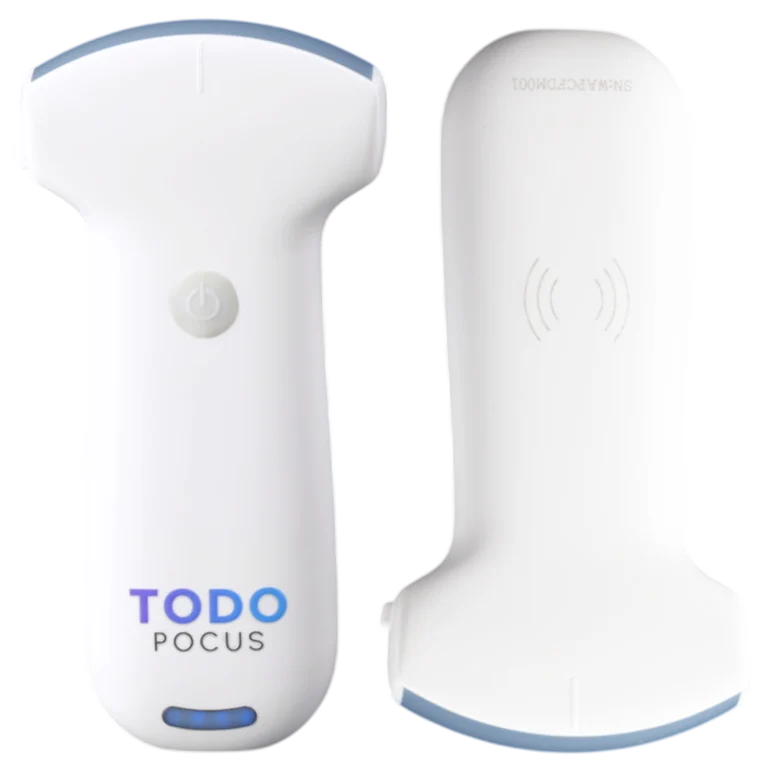
C5SH is the closest lower-cost, dedicated convex alternative in this group. Its 3.2/5.0 MHz array scans 9–30.5 cm, while 192 elements and 64 channels target stronger deep-tissue detail for abdomen, FAST, renal, bladder, lung, and transabdominal OB/GYN work (CRL, BPD, GS, FL, HC, AC). It also runs a 256-level gray scale with 5-level noise reduction for cleaner deep-abdominal images. Its 1.5-hour battery is also adequate for episodic POCUS.
- 17+ organ presets (bladder, urology, abdominal) with two customizable preset slots.
- Cable-free handling, puncture guides, and a 1,000-frame cine option. Includes color, power, and PW Doppler with local storage and DICOM.
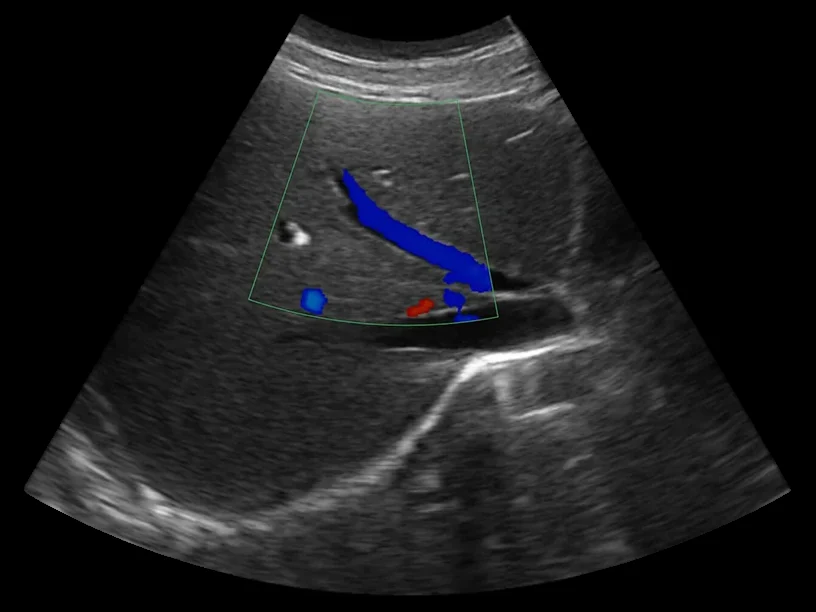
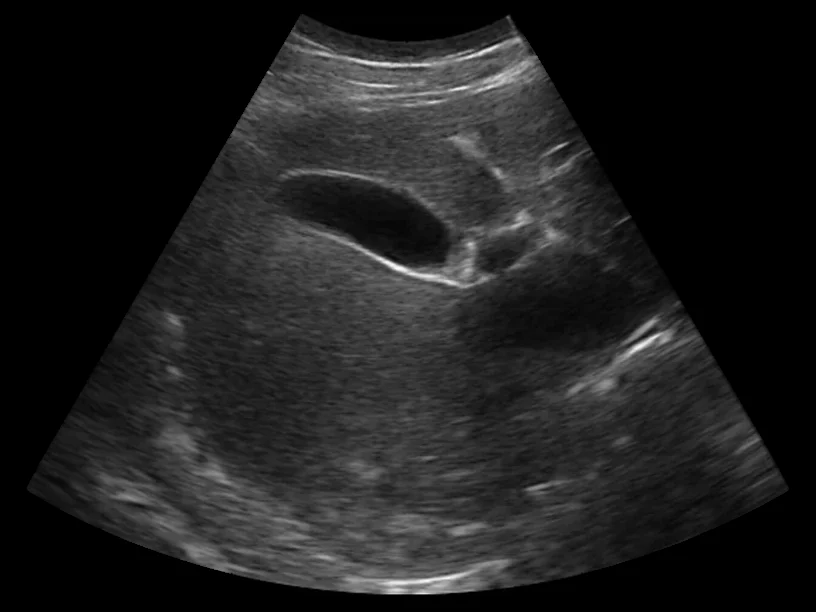
2. GE Vscan Air CL – Best Philips Lumify C5-2 Alternative for Combined Abdominal and Linear Scanning
Prezzo: $4,999 (base) | Abbonamento: $0/yr core (digital cloud/fleet tools optional) | Compatibilità: Wireless (iOS, Android)
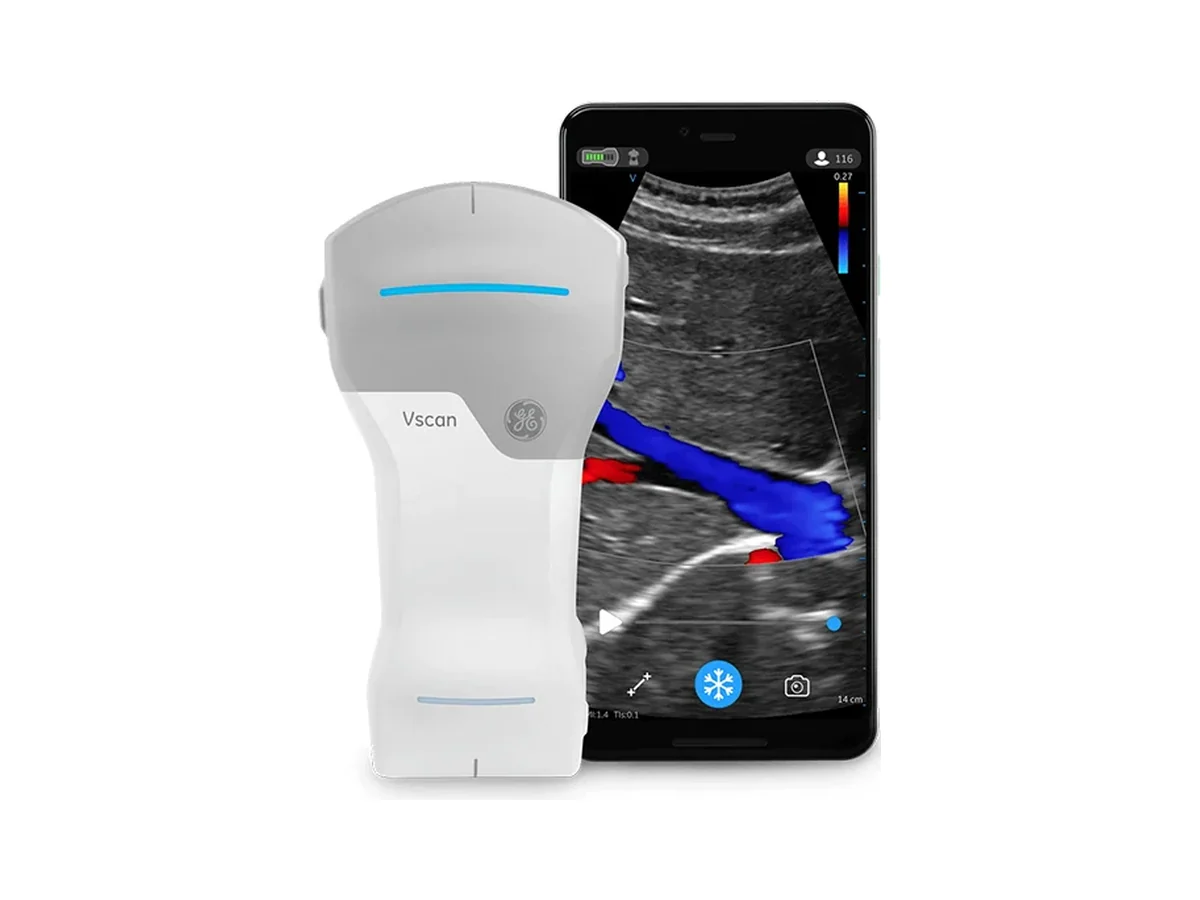
Vscan Air CL combines a 2–5 MHz curved array with a 3–12 MHz linear array, which makes it much more versatile than a C5-2 alone. The curved side covers abdominal, obstetric, pelvic, and lung work, while the linear side handles vascular, MSK, small parts, and procedures. CL makes sense when a clinic wants an established enterprise brand and two physical arrays in one wireless probe, not when the only goal is the lowest-cost convex replacement.
- B, M, color, and PW modes are available, with OB calculations and free local storage.
- The limitation is runtime—about 50 minutes only.
3. Clarius C3 HD3 – Best Philips Lumify C5-2 Alternative for Broad Primary-Care Scanning
Prezzo: $3,795 | Abbonamento: Optional $695/yr (or $2,500 one-time) Essentials for PW Doppler, OB packages & cloud | Compatibilità: Wireless (iOS, Android)
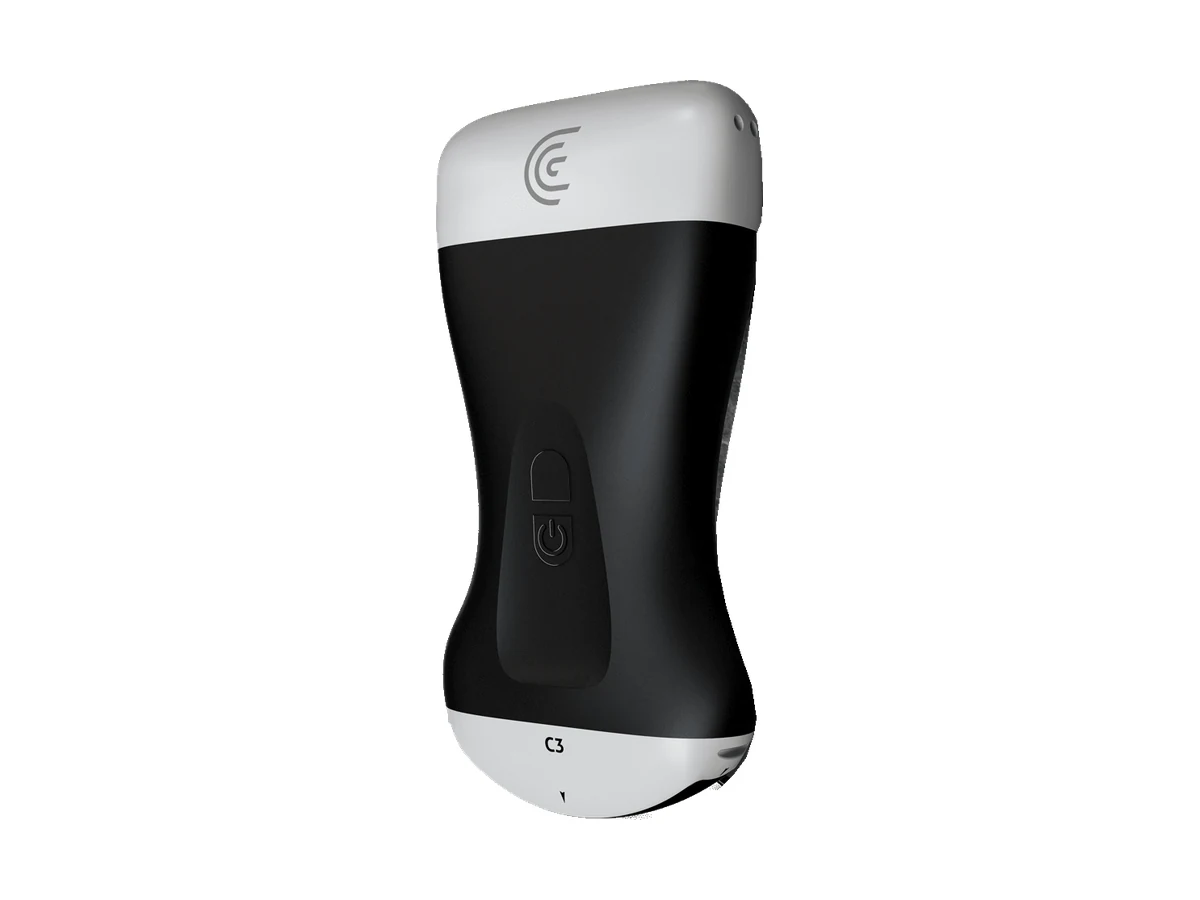
Clarius C3 HD3 is a 2–6 MHz wireless convex scanner with imaging to 40 cm, a useful margin for difficult abdominal windows. Its preset range extends beyond the abdomen and OB/GYN into bladder, lung, pelvic, prostate, selected superficial, and vascular work. Its smart calculations for bladder volume and fetal biometry are also solid additions (with membership).
- Core modes are usable without membership, while Essentials expands the platform with PW Doppler, specialty software, cloud storage, AI, voice controls, and education.
- The scanner weighs approximately 308 g, and its battery is rated for about one hour of scanning.
4. Mindray TE Air e5M – Best Philips Lumify C5-2 Alternative for No-Subscription Whole-Body Coverage
Prezzo: $4,499 (base) | Abbonamento: $0/yr recurring (optional hardware/software add-ons) | Compatibilità: Wireless (iOS, Android & Mindray TE X carts)
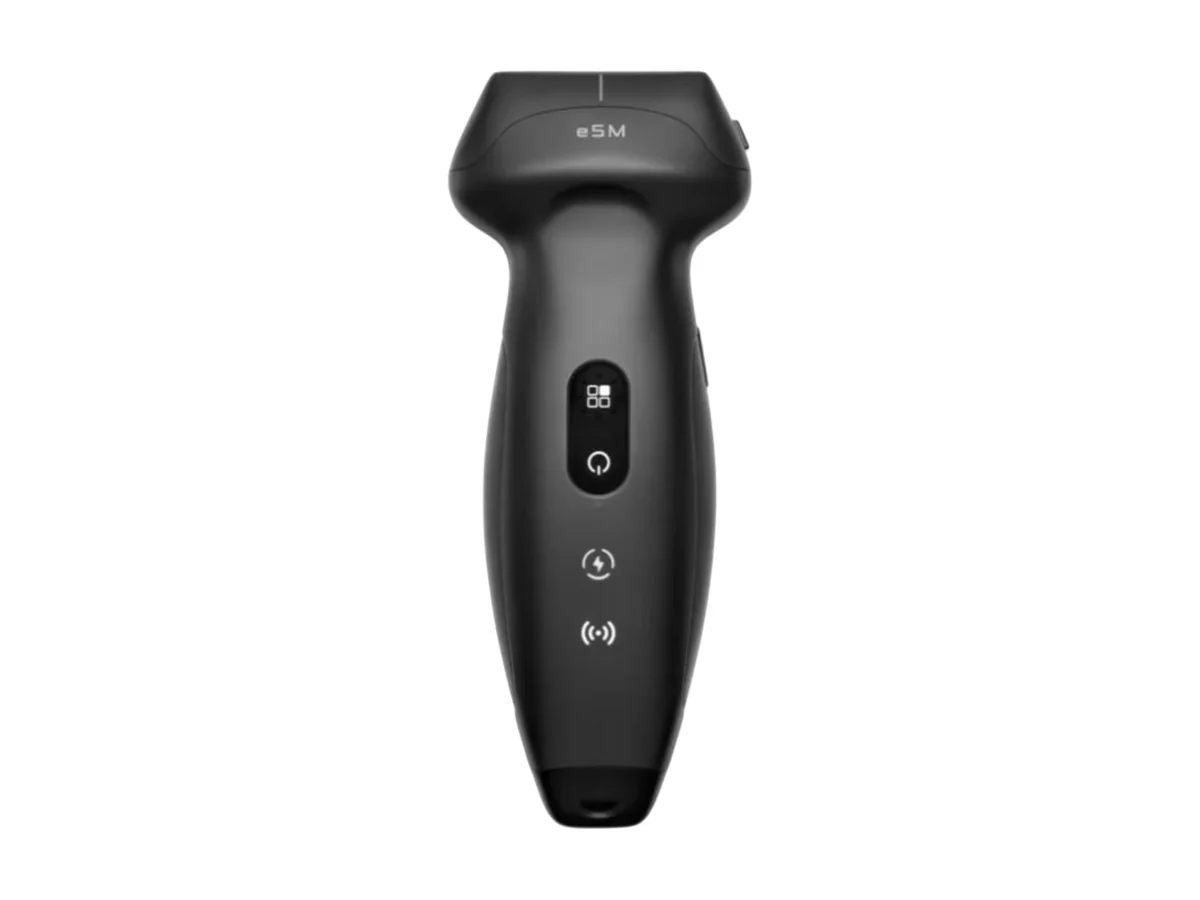
Mindray’s Matrix Thin Slice architecture supports linear and convex imaging characteristics from one wireless transducer, with deep imaging to 40 cm and 20+ exam modes across abdomen, OB/GYN, vascular, MSK, small parts, nerve, thoracic, urology, and cardiac applications. Its iWorks pre-labeled protocols and Smart Bladder/Smart Calc tools are aimed at cutting down manual steps during a busy exam list, and everything (including DICOM) ships in the base price with no locked tiers.
- At 229 g, it is heavier and more expensive ($4,499) than C5SH.
- The stated battery runtime is up to 120 minutes on a full charge; while it supports Mindray’s software-based
iNeedleneedle-visualization enhancement, it does not accept physical clip-on biopsy needle-guide brackets or magnetic navigation.
Quick Comparison: C5-2 vs. Alternatives
| Specifiche | Philips Lumify C5-2 | TodoPocus™ C5SH | GE Vscan Air CL | Clarius C3 HD3 | Mindray TE Air e5M |
|---|---|---|---|---|---|
| Physical probe | Wired curved | Wireless convex | Wireless curved + linear | Wireless convex | Wireless matrix linear/convex |
| Frequenza e profondità | 2–5 MHz; up to 30 cm | 3.2/5.0 MHz; 9–30.5 cm | Curved 2–5; linear 3–12 MHz; up to 24 cm, 8 cm linear |
2–6 MHz; up to 40 cm | Linear bands 2.0–8.2; convex bands 2.0–5.0 MHz; up to 40 cm |
| Notable features | XRES, harmonics, SonoCT, color/PW, DICOM | 192 elements/64 channels; full Doppler; puncture guides; DICOM | Two arrays; OB calculations; SignalMax; enterprise options | Deep imaging; optional AI/cloud/PW and specialty tools | 20+ modes; iTouch+, iNeedle (software), Smart tools; IP68 |
| Battery and charge time | No probe battery; powered by host; up to about 5 h continuous use | 1.5 h; 2200 mAh; USB/wireless charge | 50 min; wireless charge | About 60 min scan; wireless charging | 90–120 min; USB-C or optional Air Capsule |
| Size and weight | 114 × 45 mm; under 90 g without cable, about 136 g total | 140 × 60 × 20 mm; 180 g | 131 × 64 × 31 mm; 205 ±3 g | 146 × 76 × 32 mm; 308 g | 170 × 70 × 33 mm; 229 ±3 g |
| Compatibilità | Compatible with Android; iOS via supplied power module/kit; verify device list |
iOS, Android e Windows | iOS e Android | iOS e Android | iOS e Android |
| Archiviazione | Local device, email, network share and DICOM/PACS | Local; JPEG/PNG/MP4 and DICOM export | Local device; DICOM and optional MyImageCloud/Digital Tools | Local, cloud and DICOM listed with Membership | Local JPG/MP4; DICOM, and supported third-party/cloud routes |
| Abbonamento | No core subscription; Reacts optional | Assente | Core scanning: digital tools optional | Optional Essentials | No recurring core plan |
| Est. price USD with warranty | $5,000–$7,000; up to 5-year warranty |
$2,570; Garanzia standard di 3 anni |
$4,999 base; Garanzia standard di 3 anni |
$3,795 + $695/year or $2,500 One-Time Essentials; Garanzia standard di 3 anni |
$4,499 base; 3-year transducer warranty |
When Is Philips Lumify Still the Better Choice for You?
None of this makes Lumify a bad device; it’s simply an older architecture competing against a newer generation of wireless, battery-powered handhelds. There are still real scenarios where sticking with Lumify makes sense.
- You’re already inside a large hospital system standardized on Philips. Shared service contracts, IT security approval, and existing PACS integration with Philips’ ecosystem can outweigh a probe’s individual spec sheet.
- You value an established, long-running track record over a newer brand. Lumify has nearly a decade of clinical use and a mature installed base; some of the alternatives above are considerably newer to the market.
- You need broad third-party service network coverage. Philips’ global service and support infrastructure is more extensive than most smaller competitors’, which matters if uptime and local repair access are a priority.
- You’re not bothered by the cable. If your workflow is largely stationary (a single exam room, a fixed cart setup), the cabled design isn’t a real drawback—and it means one less battery to manage, with zero Wi-Fi interference concerns in RF-congested operating rooms. Though you still need to carry a power module if your companion device is iOS.
Choosing the Right Lumify Alternative for Your Probe Needs
Don’t shop by brand name; shop by the exam you actually do most. Test the hardest 10–20 percent of cases, not the easiest volunteer scan. For vascular access and injections, compare needle-tip visibility at your usual angle and depth; L10H-Guide is the procedure-first choice, while L14 Pro and L15 HD3 favor superficial detail.
For focused cardiac work, choose PD2 if CW Doppler is central, CD2 if vascular crossover matters, TE Air i3P for Mindray acute-care integration, or PA HD3 for deeper wireless imaging.
For abdomen and transabdominal OB/GYN, prioritize field shape, penetration in higher-BMI patients, fetal/abdominal measurements, and sustained thermal behavior.
Before ordering, confirm five details in writing:
- Regulatory clearance: Verify FDA, CE, or local regulatory approval for your country and intended clinical application.
- Included modes and measurements: Confirm which Doppler modes, specialty presets, and automated calculations are unlocked out of the box at purchase versus gated behind paid tiers.
- Phone and tablet compatibility: Check supported iOS, Android, or Windows OS versions, hardware requirements, and whether cables or external power modules are needed.
- DICOM, worklist, and local-storage behavior: Confirm whether studies can be saved locally and exported directly to PACS/DICOM without a mandatory cloud subscription.
- Total ownership cost: Calculate the three- or five-year total cost, including annual software memberships, accessories, taxes, warranty extensions, and replacement batteries or chargers.
FAQ
What is the best alternative to Philips Lumify?
TodoPocus™ D3-Ultra is the best overall value when one clinician needs linear, convex, and phased workflows without subscriptions. It offers conventional array coverage, full Doppler, local storage, DICOM, and broad measurements. Butterfly iQ3 may be better for an AI- and cloud-led program, while enterprise buyers may prefer GE, Mindray, or Clarius support ecosystems.
Can one device replace all my Philips Lumify probes?
Yes, for many focused POCUS workflows. D3-Ultra comes closest because it provides linear, convex, and phased modes in one wireless device. Butterfly iQ3 also covers whole-body presets through one semiconductor array. Neither automatically replaces comprehensive departmental ultrasound, and performance should be validated for cardiac, obstetric, difficult-abdominal, and procedure-specific cases before standardization.
Are Philips Lumify alternatives cheaper than Lumify?
Generally, yes. Alternatives in this guide range from $1,899 to $6,699 upfront, compared to Lumify’s typical $5,000–$7,000 per probe depending on transducer and vendor. Subscription-based competitors (Clarius, Butterfly) can narrow that gap over time, so compare total cost of ownership over three to five years, not just sticker price.
Does the Philips Lumify require a subscription?
No. Current Philips materials state that an outright Lumify purchase includes core software, features, ongoing updates, and new applications or presets without a mandatory subscription. However, Philips Reacts, its tele-ultrasound collaboration platform, is a separate paid add-on billed annually or as a multi-year bundle (and is supported on Android rather than iOS).
What is the best alternative to the Lumify S4-1 for cardiac imaging?
For a cardiac-first handheld, TodoPocus™ PD2 ($1,899) is compelling because it includes dedicated phased-array imaging and Continuous Wave (CW) Doppler at a fraction of the S4-1’s price. Choose TodoPocus™ CD2 ($2,350) when you also need a linear array for vascular access. Mindray TE Air i3P is stronger for acute-care hospital integration and suits teams wanting deeper measurement tools (Tissue Doppler, Auto EF) without a recurring subscription.
What is the best alternative to the Lumify C5-2 for abdominal/OB imaging?
TodoPocus™ C5SH ($2,570) is the best dedicated value alternative for abdominal, renal, bladder, FAST, and transabdominal OB/GYN work, thanks to its full gestational measurement suite and zero annual fees. Clarius C3 HD3 offers deeper scanning to 40 cm and a richer paid ecosystem; GE Vscan Air CL adds a linear array.
Punto chiave
Philips Lumify remains a reliable, well-supported system, but in 2026 it is competing against wireless, battery-powered handhelds that match its day-to-day POCUS utility at a fraction of the total cost—especially once you factor in Lumify’s cable-tethered workflow and iOS Power Module workarounds.
Ready to Upgrade to Cable-Free Bedside Ultrasound Without Subscription Fees?
- For Solo Clinicians & Multi-Specialty Clinics: Explore the TodoPocus™ D3-Ultra All-in-One Handheld Ultrasound (or compare our dedicated single-probe scanners starting at $1,899).
- For Departments, Group Practices & Custom Probe Matching: Schedule a 1-on-1 Selection Call with a TodoPocus™ Clinical Specialist to request multi-unit quotes, sample clinical cine loops, or PACS/DICOM workflow guidance.
✓ Free Global Shipping | ✓ 3-Year Standard Warranty | ✓ $0 Recurring Subscription Fees
Avvertenza: All pricing, specs, and features above are sourced from official manufacturer websites and are accurate as of the time of publishing. Prices, subscription terms, and regional availability change frequently; always confirm directly on the manufacturer’s site before purchasing.
Bibliografia
- American College of Emergency Physicians (ACEP). (2023). Ultrasound guidelines: Emergency, point-of-care, and clinical ultrasound guidelines in medicine. Annals of Emergency Medicine, 82(3), e115–e155. https://doi.org/10.1016/j.annemergmed.2023.06.005
- Spencer, K. T., Kimura, B. J., Korcarz, C. E., Pellikka, P. A., Rahko, P. S., & Siegel, R. J. (2013). Focused cardiac ultrasound: Recommendations from the American Society of Echocardiography. Journal of the American Society of Echocardiography, 26(6), 567–581. https://doi.org/10.1016/j.echo.2013.04.001
- Philips Healthcare. (2026). Lumify handheld ultrasound portfolio: L12-4 linear, S4-1 phased, and C5-2 curved array transducers. https://www.usa.philips.com/healthcare/sites/lumify-handheld-ultrasound
- TodoPocus. (2026). D3-Ultra 3-in-1 wireless handheld ultrasound scanner (Phased, Convex & Linear). https://todopocus.com/multipurpose-handheld-ultrasound/d3-ultra/
- TodoPocus. (2026). L10H-Guide wireless & USB linear ultrasound probe with magnetic needle navigation & L14 Pro high-frequency linear scanner. https://todopocus.com/linear-probe-handheld-ultrasound/l10h-guide/
- TodoPocus. (2026). PD2 phased-array handheld ultrasound with CW Doppler & CD2 phased + linear dual-array scanner. https://todopocus.com/phased-probe-handheld-ultrasound/pd2/
- TodoPocus. (2026). C5SH 64-channel wireless convex handheld ultrasound scanner for abdominal and OB/GYN POCUS. https://todopocus.com/convex-probe-handheld-ultrasound/c5sh/
- Butterfly Network. (2026). Butterfly iQ3 Ultrasound-on-Chip™ specifications and membership pricing. https://www.butterflynetwork.com/pricing
- Clarius Mobile Health. (2026). Clarius HD3 wireless handheld ultrasound scanners (L15 HD3, PA HD3, C3 HD3, and PAL HD3) & Clarius Essentials membership. https://store.clarius.com/products/package-pal-scanner-hd3
- GE HealthCare. (2026). Vscan Air SL (sector-linear) and Vscan Air CL (curved-linear) wireless handheld ultrasound specifications. https://www.gehealthcare.com/products/ultrasound/handheld-ultrasound/vscan-air-sl
- Mindray North America. (2026). TE Air i3P and TE Air e5M wireless handheld ultrasound system specifications. https://mindrayna.my.site.com/teair/product-details