

Best Handheld Ultrasound Probes for Pediatrics & Neonatal Care (2026): What Actually Matters Before You Buy

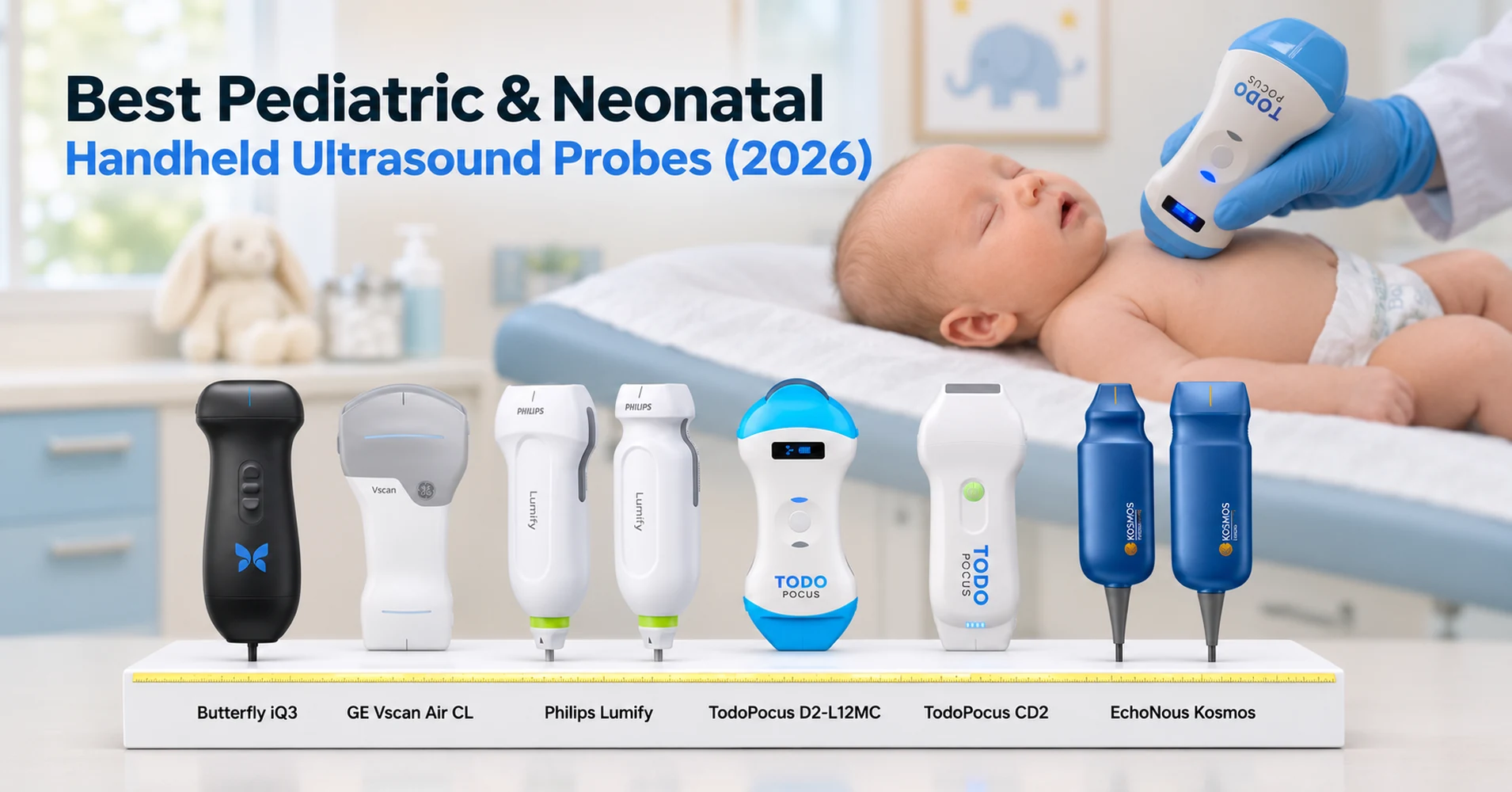
If you have ever tried scanning a 3 kg newborn with a standard adult handheld probe, you already know the frustration. A software “Pediatric” preset cannot fix a lens that is physically too wide to sit flat over an anterior fontanelle, between infant ribs, or across a flexed newborn wrist.
Shopping for a pediatric handheld ultrasound comes down to practical trade-offs that rarely jump off a brochure: actual footprint width in millimeters, whether one probe covers both neonatal cranial ultrasound and flat-linear infant hip ultrasound, whether a cord gets in the way inside an incubator, and what happens to PW Doppler or PACS archiving if you skip an annual subscription.
Quick Reference: Top Pediatric & Neonatal Handhelds at a Glance
| 最適合的用途 | 裝置 | Main Strength & Practical Trade-Off | Starting Price |
|---|---|---|---|
| Neonates, infant hips & general peds in one unit | TodoPocus™ D2-L12MC | Pairs an R20 micro-convex head with a 25 mm flat linear head and built-in angle caliper ($0/yr). Trade-off: Wireless-only; 16 cm max depth isn’t built for large adolescents. | $2,370 |
| Tablet-tethered cardiac Doppler (PW, CW & TDI) | EchoNous Kosmos | Adds CW and tissue Doppler on the Torso-One phased probe. Trade-off: No micro-convex option, no smartphone support (tablets only), and covering cardiac + linear takes two bulky wired probes (~$9,000+ before tablet). | ~$9,000+ (2-probe) |
| PICU shock echo & difficult pediatric lines | TodoPocus™ CD2 | Light 150 g phased + 25 mm linear dual-probe with both Wi-Fi and wired USB ($0/yr). Trade-off: Low-frequency cardiac head isn’t meant for neonatal fontanelles. | $2,350 |
| Older kids & hospital-approved OEM lists | GE Vscan Air CL / SL | Familiar GE image quality with no mandatory base fee. Trade-off: CL’s 64 mm curved lens is bulky on neonates; ~50-min battery. | ~$4,999 |
| Long shifts with zero probe-battery charging | Philips Lumify (L12-4 / S4-1) | Crisp L12-4 linear imaging powered straight from your tablet. Trade-off: Wired cord; no mobile micro-convex option, so covering sector + linear takes two pricey probes. | ~$6,000+ / probe |
| Large residency cohorts & guided teaching | Butterfly iQ3 | One probe switches 1–12 MHz digitally with strong teaching tools. Trade-off: Wired cable, wide flat head on tiny chests, and mandatory annual fees. | $3,899 |
If you are weighing options for a nursery, NICU, PICU, or outpatient clinic, here is an honest look at how these six probes actually compare day to day.
目錄
6 Best Handheld Ultrasound Probes for Pediatrics & Neonatal Care
1. TodoPocus™ D2-L12MC — Best One-Probe Fit for Neonates, Infant Hips & Outpatient Pediatrics

規格一覽:
- 價格: $2,370 one-time purchase ($0/year software or export fees)
- Arrays & Footprint: Dual-head — R20 micro-convex (5/7 MHz, 6–16 cm) + 25 mm flat linear (10/12 MHz, 2–8 cm)
- 連線 & 電池: Wireless Wi-Fi to iOS, Android & Windows; 2.5-hour battery (wireless charging)
- Weight & Build: 230 g, fanless IP67/IPX7 sealed casing
On a full-size cart, covering newborn rounds and general pediatrics usually takes two separate probes: a tight micro-convex head and a small-footprint linear “hockey-stick” or vascular array. The TodoPocus™ D2-L12MC puts both of those shapes on opposite ends of one wireless unit, which solves the single biggest headache when shopping on a clinic or nursery budget.

You use the R20 micro-convex end for fontanelle cranial sweeps, intercostal lung checks, and infant abdomens, then flip to the flat 25 mm linear end for Graf hip checks, pylorus measurements, and tiny IVs. Because the app unlocks its B-mode angle caliper, 1,000-frame cine loop,以及 脈衝波都卜勒 (including RI calculations) out of the box, you are not stuck paying extra later just to measure hip angles or save DICOM clips to PACS.


- Covers both cranial and Graf hip geometry in one purchase, avoiding a second $3,000+ linear scanner.
- 25 mm narrow linear face sits much flatter on newborn wrists, ankles, and necks than standard 40–50 mm adult linear heads (for 1–3 mm surface veins that collapse easily, TodoPocus also sells 4 mm sterile gel standoff pads for $140 per 50-pack).
- 2.5-hour continuous battery easily outlasts the 50- to 60-minute runtime common on other wireless handhelds, with no cord trailing into an incubator.
- Wireless-only design (Wi-Fi connection and wireless charging, with no USB cable mode), so you cannot plug in a cord if you forget to charge it overnight.
- 16 cm maximum depth on the micro-convex side is sized for neonates through school-age children rather than full-grown, high-BMI teenagers.
2. EchoNous Kosmos (Torso-One & Lexsa) — Tablet-Tethered Option for Pediatric Cardiac Doppler
規格一覽:
- 價格: Quote-based (~$4,500+ per probe; ~$9,000+ for a 2-probe kit before tablet, ~$7,700+ for 1-probe Kosmos Mobile w/ iPad, or under $21K for full Kosmos Plus)
- Arrays & Footprint: Two separate wired probes (no micro-convex) — Torso-One phased (20.7 × 16 mm, 1.5–4.5 MHz) & Lexsa linear (38 × 8 mm, 4–11 MHz)
- 連線 & 電池: Wired USB-C to compatible iOS/Android tablets only (smartphones unsupported); ~3 hours off tablet battery
- Weight & Build: 275 g (Torso-One) / 280 g (Lexsa), IP67, 5-year transducer warranty
EchoNous pitches Kosmos closer to a compact tablet-cart replacement than a coat-pocket probe. Its Torso-One phased array includes continuous-wave (CW) and tissue Doppler alongside PW Doppler—useful in a PICU or cardiology clinic when quantifying high-velocity tricuspid or valvular jets. While Kosmos scored well on cardiac and torso grayscale in a six-device evaluation on an older standardized pediatric model (Leung et al., POCUS Journal, 2025), that study did not test neonatal incubators, newborn fontanelles, or infant hip screening.
Once you move down to neonates and infants, the hardware trade-offs add up quickly. EchoNous does not make a micro-convex probe: the Torso-One’s 1.5–4.5 MHz range is tuned for deeper chest and abdominal penetration rather than fine near-field neonatal brain detail, while the Lexsa’s 38 mm linear face is wider than an average 26 mm newborn fontanelle. Both probes are also bulky (150 × 56 × 35 mm, 275–280 g—half of the reviewers in that same 2025 study flagged probe size as a drawback) and draw too much power to run on an iPhone or Android phone, locking you into carrying a wired tablet and two separate probes.
- CW, PW, and tissue Doppler on the Torso-One suit older pediatric cardiology checks, though several AI tools (such as Auto EF) remain labeled for adults.
- No micro-convex transducer in the lineup; the 1.5–4.5 MHz cardiac phased array sacrifices shallow neonatal cranial detail, and covering linear exams requires swapping a second wired probe.
- No smartphone support (tablets only): phone USB ports cannot power Kosmos probes, so you cannot plug into a pocket phone on quick ward calls.
- Bulky 275–280 g corded handles feel large on preterm chests and add cable management inside NICU isolettes.
- High multi-piece cost: pairing Torso-One + Lexsa lands around $9,000+ before adding a compatible tablet, with complete Kosmos Plus setups running up to $21,000.
3. TodoPocus™ CD2 — Best Lightweight Pick for PICU, Pediatric ER & Central Lines

規格一覽:
- 價格: $2,350 one-time purchase ($0/year software fees)
- Arrays & Footprint: Dual-head — Phased array (2.2/3.6 MHz, 9–19 cm) + 25 mm flat linear (7.5/10 MHz, 2–10 cm)
- 連線 & 電池: 無線Wi-Fi plus wired USB cable (iOS, Android & Windows); ~1.5-hr wireless runtime
- Weight & Build: 150 g
In the PICU, pediatric ER, or OR, your day usually revolves around shock checks, effusions, and tough vascular access rather than newborn fontanelles. That is where the TodoPocus™ CD2 makes more sense than a micro-convex unit: it pairs a true cardiac phased array on one end with the same compact 25 mm linear footprint on the other, at less than half the price of a ~$4,999 GE Vscan Air SL.


At 150 g, it feels lighter than your phone in a scrub pocket. Just as important for critical care and anesthesia, it connects over both Wi-Fi and a direct USB cable—so if hospital Wi-Fi is congested in the OR or a difficult line runs long, you can plug straight into a tablet or Windows cart laptop and keep scanning without watching the battery bar.
- True cardiac + narrow vascular pairing covers focused echo (EF, SV, LVIDd/s) and small-vessel line placement in one 150 g unit.
- Wireless + wired USB dual mode gives PICU and anesthesia teams a reliable backup when battery or hospital Wi-Fi gets tight.
- Full Color, Power, and PW Doppler plus DICOM export are included upfront with no recurring fees (if you only do shallow <5.5 cm lung and IV work, TodoPocus also makes a dedicated 10/14 MHz L14 linear probe at $2,350).
- 2.2/3.6 MHz cardiac phased head uses PW and Color Doppler and is tuned for pediatric chests rather than neonatal fontanelles—pick the D2-L12MC for NICU cranial scans, or pair the 120 g TodoPocus™ PD2 ($1,899) if you specifically need pocket Continuous Wave (CW) Doppler for high-velocity valve jets.
4. GE HealthCare Vscan Air CL & SL — Best Familiar Hospital Brand for Older Kids
規格一覽:
- 價格: ~$4,999 each ($0 mandatory base fee; cloud and AI packages extra)
- Arrays & Footprint: CL: 64 mm curved (2–5 MHz) + 40 mm linear (3–12 MHz) | SL: Phased sector + 40 mm linear
- 連線 & 電池: Wireless Wi-Fi to iOS & Android; ~50-minute battery
- Weight & Build: 205 g (CL) / 218 g (SL), IP67 drop-tested
When hospital biomed or value-analysis committees insist on a legacy brand name, GE’s Vscan Air is usually the easiest wireless approval to get. Pediatric POCUS physicians consistently like its clean app layout, sturdy drop-tested shell, and natural B-mode contrast, and core scanning works locally without a mandatory subscription.
Size and lineup splitting are the two things to weigh first. GE does not make a micro-convex Vscan Air: the CL’s curved lens is 64 mm wide—built for adult abdomens—so it performs nicely on a 10-year-old’s belly or FAST exam, but overhangs badly on a preemie’s fontanelle or ribcage. GE also separates abdominal curved (CL) and cardiac sector (SL) modes into two ~$4,999 probes—so if your caseload is mostly older kids and adolescents where standard footprints fit fine, a 3-in-1 wireless scanner like the TodoPocus™ D3-Ultra ($3,470 Clinical White / $3,570 Space Silver) is worth comparing, since it puts convex, phased, and linear arrays into one handle at about a third of the two-probe GE cost.
- Easy hospital procurement sign-off with dependable grayscale and Color/PW Doppler out of the box.
- Adult-sized 64 mm curved lens on the CL is too wide for tiny neonatal windows, and even the 40 mm linear side feels wide on a newborn wrist.
- 電池連續運作時間約 50 分鐘 (with no wired USB scanning option) drains fast on busy teaching rounds.
- Split two-probe lineup means getting both curved abdominal (
CL) and cardiac sector (SL) coverage runs close to $10,000, whereas a 3-in-1 probe like the D3-Ultra covers all three formats with a 2-hour battery in one unit.
5. Philips Lumify (L12-4 & S4-1) — Best Wired Option When You Never Want to Charge Probes
規格一覽:
- 價格: ~$6,000–$9,995 per probe (~$12,000–$19,990 for a 2-probe pediatric setup)
- Arrays & Footprint: Separate wired probes — L12-4 linear (34 mm, 4–12 MHz) & S4-1 phased (25.5 mm, 1–4 MHz)
- 連線 & 電池: Wired USB cable only, powered by the host tablet/phone ($0 mandatory subscription)
- Weight & Build: ~96–136 g probe head (excluding cable and iOS power module)
In busy academic pediatric EDs, Philips Lumify has two loyal selling points: the L12-4 linear probe produces standout soft-tissue images for appendicitis, intussusception, and lung checks, and there is no internal probe battery to die mid-shift because it pulls power straight from your tablet.
One catalog detail catches a lot of buyers off guard, though: Philips’ well-known C8-5 neonatal micro-convex probe is only for cart consoles (Affiniti, EPIQ, CX50)—there is no micro-convex transducer in the mobile Lumify lineup. Covering both sector and linear pediatric exams means buying, carrying, and wiping down two separate wired probes at near-cart prices.
- Top-tier 4–12 MHz linear image quality and multi-hour wired scanning without charging cradles.
- No mobile micro-convex probe, and assembling an
L12-4+S4-1pair easily runs $12,000 to $20,000. - Wired cable gets in the way inside NICU isolettes, and pairing with iPads or iPhones still requires an external Lumify Power Module bracket (see our Lumify S4-1 vs. Vscan Air SL vs. TodoPocus CD2 comparison for a closer look).
6. Butterfly iQ3 — Best for Large Pediatric Residency Programs
規格一覽:
- 價格: $3,899 hardware + mandatory $299/year (Core) or $420/year (Advanced) membership
- Arrays & Footprint: Single wide flat CMUT silicon chip (1–12 MHz digital presets, up to 30 cm)
- 連線 & 電池: Wired cable only to iOS & select Android devices; ~2-hour battery
- Weight & Build: 300 g, IP67
If your main job is training 30 pediatric residents and medical students on one standardized platform, Butterfly’s software ecosystem does a lot of heavy lifting. Switching from an abdominal preset to a lung or vascular view on a squirming toddler takes one tap without flipping the probe, and Biplane vascular imaging plus ScanLab tutorials are genuinely helpful for learners.
For everyday NICU or private-clinic ownership, the physical probe and billing model are less convenient. Even in a neonatal preset, the tip is still a wide, flat rectangular plate attached to a phone cable—awkward inside a small incubator or over a curved fontanelle—and the recurring fees never stop.
- One-tap digital preset switching and Biplane IV views make trainee supervision smoother.
- Wide flat rectangular head and 300 g wired body don’t sit as naturally in tight newborn windows as a cordless R20 micro-convex probe.
- Mandatory subscription omits PW Doppler on the $299/yr Core plan (requiring $420/yr Advanced), charges extra for hospital PACS middleware, and blocks saving new studies if your plan lapses (more details in our Butterfly iQ3 review).
Side-by-Side Comparison: Specs, Footprints & Real 3-Year Cost
Sticker prices can be misleading once you add a second probe or unlock PW Doppler and DICOM archiving. Here is what each setup actually looks like over three years.
| 功能 | TodoPocus™ D2-L12MC | EchoNous Kosmos (2-Probe) | TodoPocus™ CD2 | GE Vscan Air CL | Philips Lumify (2-Probe) | Butterfly iQ3 |
|---|---|---|---|---|---|---|
| Arrays Included | R20 Micro-Convex + 25 mm Linear | Torso-One Phased + 38 mm Lexsa Linear | Phased + 25 mm Linear | 64 mm Curved + 40 mm Linear | L12-4 Linear + S4-1 Phased | Single CMUT chip (emulated) |
| Fontanelle + Graf Hip in 1 Unit? | Yes (both native) | No — 2 wired probes (no micro-convex; 1.5–4.5 MHz phased) | Hip / vascular + cardiac echo | Hip yes; curved end bulky on fontanelle | No — requires swapping 2 wired probes | Emulated (flat wide lens) |
| 連接方式 | Cordless Wi-Fi | Wired USB-C only | Wi-Fi + Wired USB | Cordless Wi-Fi | Wired USB only | 僅能透過有線連接 |
| OS Support | iOS, Android, Windows | iOS, Android (tablets only) | iOS, Android, Windows | iOS, Android | Android (iOS w/ module) | iOS, select Android |
| Battery Runtime | 2.5 小時 | Powered by tablet (~3 hrs on iOS) | 約1.5 hrs (unlimited on USB) | 約50分鐘 | Powered by tablet | 約2小時 |
| PW Doppler & Angle Caliper | Included standard | PW, CW & TDI in Plus / Mobile kits | Included standard | 已包含 (check app calipers) | Included standard | PW requires $420/yr Advanced |
| DICOM / PACS Export | Local DICOM free | DICOM + USB export | Local DICOM free | Local DICOM free | 已包含 | Paid enterprise add-on |
| 前期硬體費用 | $2,370 | ~$9,000+ 2-probe kit (~$4,500+/probe, tablet extra) | $2,350 | ~$4,999 | ~$12,000–$19,990 | $3,899 |
| 3-Year Total Cost* | $2,370 | ~$9,000 + tablet (2 probes) | $2,350 | ~$4,999 | ~$12,000–$19,990 | $5,159 (w/ PW Doppler) |
*3-Year Total Cost includes the software tier required to use Pulsed Wave Doppler (Butterfly Advanced $420/yr). Kosmos: about $4,500 per probe in early 2024 (Leung et al., 2025), tablet extra; EchoNous lists the complete Kosmos Plus package under $21K.

5 Buying Details Most Spec Sheets Gloss Over
When colleagues ask what they wish they had checked before ordering a pediatric POCUS probe, it almost always comes down to these five things rather than raw megahertz numbers:
1. The “One Probe vs. Two” Trap (Cranial + Graf Hips)
If your practice only scans older kids’ bellies or only places IVs, a single-purpose probe is fine. But if you cover newborn rounds or outpatient infancy—where you want a small curved head for fontanelles/ribs 與 a flat linear face so the iliac baseline stays straight on Graf hip checks—make sure both arrays live on the same handle. Buying a single-head wireless micro-convex scanner and realizing later that you still need a separate linear probe immediately doubles your cost and leaves you juggling two chargers.
2. Actual Lens Width in Millimeters (Not Software Presets)
Almost every handheld vendor advertises a “Pediatric” or “Neonatal” app preset. All a preset changes is gain, depth, and focal zone—it cannot shrink a 64 mm adult convex face or a wide rectangular chip head. When comparing types of ultrasound probes for infants under 10 kg, check the physical lens spec: an R15–R20 micro-convex 以及 25 mm linear footprint save you constant gel gaps over tiny ribs, clavicles, and wrists.

3. Incubator Cords vs. Mid-Rounds Battery Drop-Off
In a Level III NICU, threading a probe cable through an isolette port is a hassle for infection control and always feels one tug away from catching an endotracheal tube or umbilical line. Cordless Wi-Fi probes (D2-L12MC, Vscan Air) are much cleaner to slip into a sterile cover or wipe down between incubators—just pay attention to continuous scan time, since a 50-minute battery goes fast on morning rounds. In the PICU or OR, where cords are easier to manage and cases run long, having a wired option (CD2, Lumify, 或 Kosmos) avoids mid-procedure shutdowns.
4. On-Screen Angle Calipers & Paywalled PW Doppler
Don’t assume every mobile ultrasound app includes the exact measurement tools you are used to on a radiology cart. Before buying, confirm two software items:
- Manual B-mode Angle Caliper: Essential if you plan to document Graf α and β hip angles right on the tablet rather than eyeballing images (and a long 1,000-frame cine loop helps immensely when scrolling back to catch the one frame where a 6-week-old wasn’t kicking).
- Unlocked Pulsed Wave Doppler: If you sample cerebral ACA resistive indices or check vascular flow velocities, verify that PW Doppler works without an active annual subscription.
5. PACS Archiving & Getting Pediatric CPT Codes Right
If your clinic or department bills for bedside scans, payers require permanently archived images alongside your note—so having subscription-free DICOM export pays for the probe quickly (often within 25 to 35 reimbursed exams). Two quick coding reminders that frequently trip up pediatric offices:
| Exam Type | CPT Code | Common Billing Catch to Avoid |
|---|---|---|
| Infant Hip — Dynamic | 76885 | Difference vs. 76886 is physician dynamic stress manipulation (Harcke/Barlow), 不 bilateral vs. unilateral. |
| Infant Hip — Static / Limited | 76886 | Use for static Graf coronal angle checks or harness follow-ups without dynamic stress maneuvers. |
| Neonatal Cranial (Fontanelle) | 76506 | Bill 76506 for transfontanellar head scans—don’t confuse it with 76800 (infant spinal canal / sacral dimple). |
| Limited Abdomen / Chest / IV | 76705 76604 +76937 | Focused pylorus or intussusception (76705), lung (76604), and vascular access add-on (+76937 with saved entry image). |
Bottom Line: Which One Makes Sense for Your Team?
There is no single “best” probe for every pediatric setting, because a newborn nursery, a trauma bay, and a residency program have very different priorities:
- If you want one cordless probe for NICU cranial scans, Graf infant hips, pylorus checks, and small IVs without recurring fees:
👉 Go with the TodoPocus™ D2-L12MC ($2,370). Having both an R20 micro-convex head and a 25 mm flat linear head—with the angle caliper, PW Doppler, 2.5-hour battery, and local DICOM unlocked from day one—covers newborn and general pediatric workflows without buying two scanners. - If you work mainly in PICU, pediatric ER shock, or anesthesia:
👉 Pick the TodoPocus™ CD2($2,350) for its 150 g cardiac phased + 25 mm linear combo and USB cable backup (or step up to the 3-in-1 TodoPocus™ D3-Ultra at $3,470 if you also scan plenty of full-grown teenagers). - If your hospital requires a legacy OEM brand or a centralized trainee cloud:
- 選擇 GE Vscan Air CL or SL (~$4,999) when your caseload is mostly school-age children and biomed wants GE on the label.
- 選擇 Philips Lumify (~$6,000+/probe) if you have capital budget for separate probes and want continuous tablet-powered linear imaging in the ED.
- 選擇 EchoNous Kosmos (~$9,000+ 2-probe kit, plus tablet) if your cardiology or PICU service specifically wants tablet-based CW and tissue Doppler and doesn’t mind swapping wired probes, or Butterfly iQ3($3,899+方案費用) for large residency teaching cohorts.
Comparing probes for your clinic, nursery, or hospital division? Browse the TodoPocus™ Pediatrics & Neonatology lineup 或 聯絡我們的團隊 if you want to check PACS compatibility or multi-unit pricing.
常見問題
Can I use a single micro-convex probe for both neonatal head scans and Graf infant hip screening?
Not if you are measuring formal Graf α and β angles. A micro-convex probe is ideal for the anterior fontanelle, but its curved beam bends the straight iliac cortex needed as your Graf baseline. If you do both exams, look for a dual-head unit like the TodoPocus™ D2-L12MC that gives you an R20 micro-convex on one side and a flat 10/12 MHz linear array on the other.
Why does probe footprint matter more than “pediatric presets” on infants?
Software presets optimize frequency and gain, but they cannot change physical contact area. A 60–64 mm adult curved probe bridges across a newborn’s ribcage or 2 cm fontanelle, leaving air gaps at the edges. A true micro-convex head and a narrow (~25 mm) linear head maintain clean skin contact without heavy pressure.
What is the difference between CPT 76885 and 76886 for infant hip ultrasound?
It comes down to dynamic stress testing rather than one hip versus two. Use CPT 76885 when the physician or qualified clinician personally performs real-time dynamic manipulation during the exam, and CPT 76886 for static imaging (such as standard Graf coronal views) without dynamic maneuvers.
Which handheld pediatric ultrasounds work without an annual subscription?
The TodoPocus™ lineup (D2-L12MC, CD2, D3-Ultra), GE Vscan Air (base app), EchoNous Kosmos, and Philips Lumify all let you scan, use Color and PW Doppler, and export local DICOM images without a mandatory yearly fee. Butterfly iQ3 requires an active annual plan to save studies.
Are cordless probes practical inside NICU incubators?
In most NICUs, cordless probes are easier to manage than wired ones because no cable runs through the isolette port to snag lines or carry bacteria between beds. Sealed IP67/IPX7 units wipe down quickly with standard hospital disinfectant wipes or slip completely inside a single sterile sheath.
免責聲明: Pricing, specifications, and CPT coding notes are based on manufacturer listings and AMA coding guidelines current at publication. Always verify local payer reimbursement rules and current vendor specifications before purchasing.
參考資料
- Shaw, B. A., Segal, L. S., & Section on Orthopaedics. (2016). Evaluation and referral for developmental dysplasia of the hip in infants. 兒科, 138(6), e20163107. https://doi.org/10.1542/peds.2016-3107
- Graf, R., Mohajer, M., & Plattner, F. (2013). Hip sonography update: Quality-management, catastrophes – tips and tricks. Medical Ultrasonography, 15(4), 299–303. https://doi.org/10.11152/mu.2013.2066.154.rg2
- Singh, Y., Tissot, C., Fraga, M. V., et al. (2020). International evidence-based guidelines on Point of Care Ultrasound (POCUS) for critically ill neonates and children (ESPNIC). 重症照護, 24(1), 65. https://doi.org/10.1186/s13054-020-2787-9
- Leung, S. K., Dancel, R., Soni, R. N., et al. (2025). Comparison of six handheld ultrasound devices by pediatric point of care ultrasound (POCUS) experts. POCUS Journal, 10(1), 141–156. https://doi.org/10.24908/pocusj.v10i01.18722
- American Medical Association (AMA). (2026). CPT® 2026 Professional Edition: Diagnostic Ultrasound (76506, 76604, 76705, 76800, 76885, 76886, 76937). https://www.ama-assn.org/
- TodoPocus. (2026). D2-L12MC Neonatal & Pediatric Dual-Probe & CD2 Phased + Linear Handheld Ultrasound Specifications. https://todopocus.com/specialty/pediatrics/
- EchoNous. (2026). Kosmos Torso-One & Lexsa Transducer Specifications and Kosmos Plus Configuration. https://echonous.com/kosmos-plus/
- GE HealthCare。(2026年)。 Vscan Air CL & SL Handheld Ultrasound Specifications. https://www.gehealthcare.com/products/ultrasound/handheld-ultrasound/vscan-air-cl
- Philips Healthcare. (2026). Philips Lumify (L12-4, S4-1, C5-2) & Cart-Based C8-5 Transducer Specifications. https://www.usa.philips.com/healthcare/sites/lumify-handheld-ultrasound
- Butterfly Network。(2026年)。 Butterfly iQ3 Specifications & Membership Plans. https://www.butterflynetwork.com/pricing

