

Portable Ultrasound Machines (2026): What $3K, $15K and $40K Actually Buy — 14 Models Compared

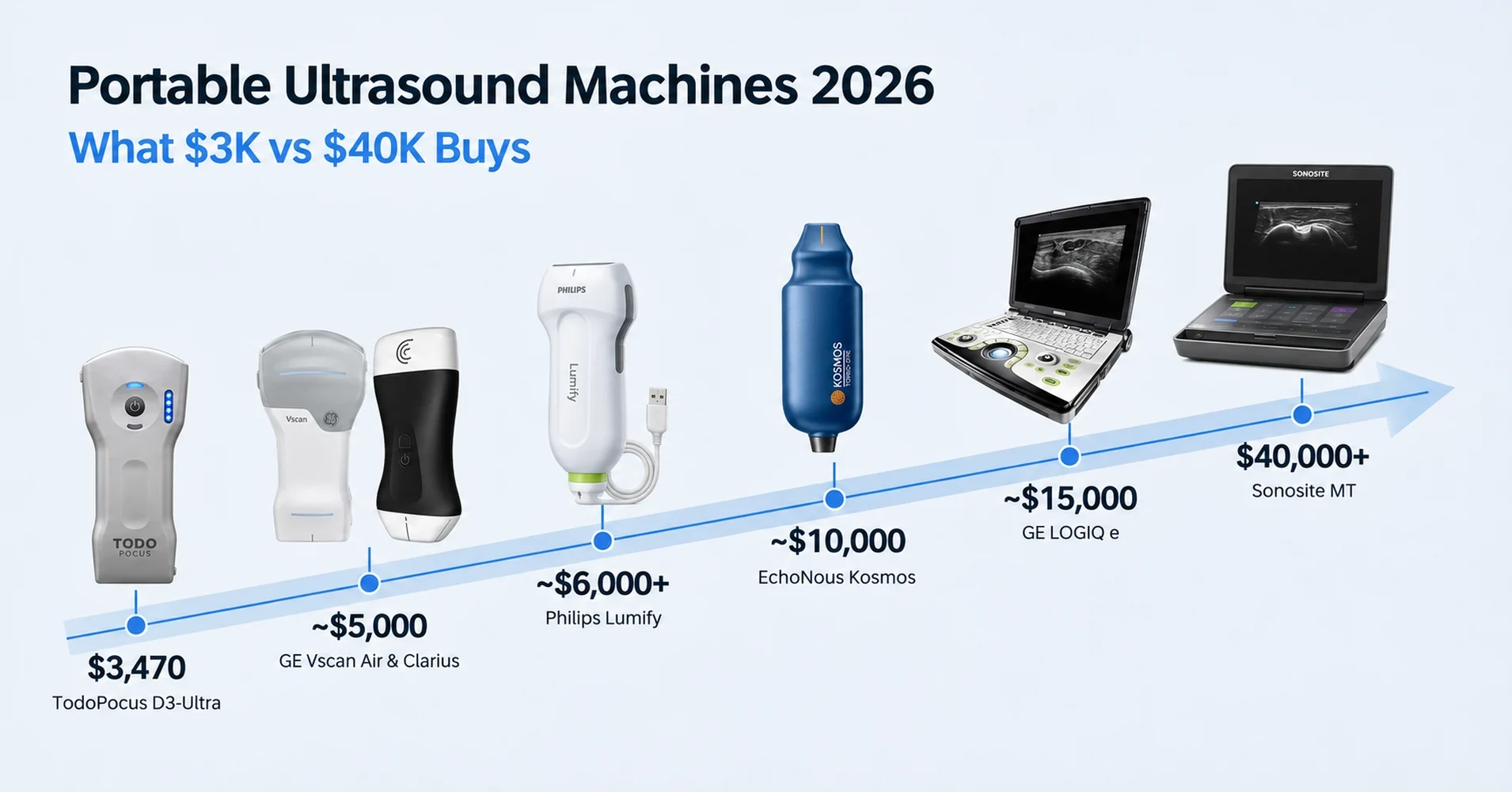
About $3,000 buys a portable ultrasound machine that handles focused bedside questions and procedure guidance: a wireless handheld. Around $15,000 buys either a premium cardiac probe with tissue Doppler, or an entry or refurbished laptop console. About $40,000 buys a new name-brand console with TEE, ECG gating and multiple probe ports.
When you open a practice or add ultrasound to one, you often get two quotes in the same week. One is around $3,000. The other is closer to $38,000. Most buying guides list specs for both and stop there. They never say what the extra $35,000 actually gets you, or when it’s worth paying.
That’s what this guide is built around. We group 14 devices into three budget tiers. For each tier, you’ll see what the money buys, what it can’t do, and the signs that you’ve outgrown it.
Prices reflect public list prices or dealer quotes as of November 2026. Models within each tier are not ranked strictly. For hands-on detail on individual handhelds, see our handheld ultrasound guide.
Portable Ultrasound Machines at a Glance
| Budget | What You’re Buying | What It Covers | What It Can’t Do | Models in This Guide |
|---|---|---|---|---|
| $2,300–$6,000 | Handheld (mostly wireless) | Focused bedside exams, procedure and injection guidance, one device per room | TEE, ECG-gated echo, complete studies; tissue Doppler is rare | TodoPocus D3-Ultra, CD2 and L20Pro; GE Vscan Air CL/SL; Mindray TE Air e5M; Butterfly iQ3; Clarius PAL HD3; Vave Universal/Phased; Philips Lumify |
| $6,500–$21,000 | A fork: premium cardiac probe або entry/refurbished console | Tissue Doppler and AI cardiac tools, або multiple probe ports with full reports | Each path covers only half of that list | EchoNous Kosmos (plus Mindray TE Air i3P with TDI); GE LOGIQ e (refurbished); SonoScape E2 |
| $25,000+ | New name-brand console | TEE, ECG gating, durability, OEM service | Pocket portability; works in one room at a time | FUJIFILM Sonosite MT/PX; Mindray MX7 |

Зміст
Start Here: 5 Things a Handheld Can’t Do
Rule things out first. If any of these five is part of your regular work, go straight to Tier 3, or the console path in Tier 2.
- TEE. You need a dedicated transesophageal probe and a system built to drive it.
- ECG-gated echo. Timing-dependent measurements in a complete echo study rely on ECG gating.
- Several specialty probes on one system. Think convex, high-frequency linear, endocavity and phased, all in the same day.
- Complete diagnostic studies with full reports. Billing for complete exams calls for full measurement packages and reporting.
- Long sessions on difficult windows. Over long, continuous scans on hard-to-image patients, handheld heat management and image ceiling become the bottleneck.
One honest caveat. CW and tissue Doppler are rare in handhelds, but not absent. The TodoPocus™ PD2 ($1,899) is a phased-array handheld with CW Doppler. The Mindray TE Air i3P offers TDI as a paid add-on, and EchoNous Kosmos offers both CW and TDI. If CW is all you’re missing, Tier 1 still works. If you need tissue Doppler, look at Tier 2’s first path.
Need none of the five? Tier 1 will probably cover you.
Tier 1 ($2,300–$6,000): Handheld Portable Ultrasound Devices
What This Budget Buys
A handheld answers focused questions quickly. Is there free fluid? Is the IVC collapsing? Where’s the needle tip? It also guides vascular access, nerve blocks and joint or filler injections. At this price, you can put one in each exam room, or carry one to house calls and nursing homes.
What You Give Up
The five items above. You also accept a lower image ceiling on difficult patients, and battery runtimes that range from under an hour to about three.
The One Decision That Matters Here: One Multi-Head Probe or Several Single-Head Probes
If you need more than one array type, compare a dual-head or 3-in-1 unit against buying two or three single-head probes. The total price differs a lot. So does the daily routine of cleaning, storing and keeping several devices charged.
The 9 Handhelds
These are shorter than our full reviews, but each one covers what you need to decide: what the device is like in daily use, where it falls short, and who should pick something else.
1. TodoPocus™ D3-Ultra — One Probe for General Practice ($3,470)
Key specs: Convex, phased and linear modes · 192 elements, 64 channels · 30 cm depth · PW with EF/SV calcs · iOS, Android and Windows · IP67 · about 2 hours of scanning
Most small clinics don’t need three probes. They need one that can switch between them. The D3-Ultra puts convex, phased and linear modes on a single wireless unit. In a typical visit, you check the gallbladder and kidneys on the convex setting, switch to phased for a quick look at LV function or an effusion, then go linear for an IV or a knee injection. Same device, same app.

The software is unlocked from day one. PW Doppler, EF/SV calculations and local DICOM/MP4 export carry no yearly fee. It also runs natively on Windows, so images can go straight to the exam-room PC. It comes with a 3-year warranty, a 30-day trial and an aluminum carrying case. A Space Silver edition with a thermal-optimized housing costs $3,570.


- Choose it if: You want one device to cover most of general practice, urgent care or house calls, without a subscription.
- Look elsewhere if: You grade valve gradients with CW Doppler (the PD2 below covers that), or you need 14–20 MHz detail for small tendons or facial vessels. At 263 g, it’s also heavier than single-head probes, though lighter than carrying three.
- Read more: handheld ultrasound guide · D3-Ultra vs. Vscan Air CL vs. Butterfly iQ3
2. GE HealthCare Vscan Air CL / SL — The Big-Brand Pick (~$4,995 each)
Key specs: CL: curved + linear · SL: sector + linear · SignalMax crystal imaging · IP67, drop-tested · about 50 minutes per charge · iOS and Android
GE’s two dual-head handhelds are the safe-name choice. The CL pairs a curved array with a linear one for abdominal and procedural work. The SL swaps the curved array for a sector array for cardiac and lung. Grayscale is clean, particularly at depth. Core imaging, including Color and PW, needs no subscription; GE charges only for optional cloud and AI tools.
In a private practice, the GE name helps when you share images with a hospital or when partners already use GE systems. The catch is coverage. Neither model does both abdomen and heart well, so covering both means buying both, about $10,000. Continuous scan time is around 50 minutes. The CL’s curved face is also fairly wide, which can be awkward on children and narrow rib spaces.
- Choose it if: The brand matters to your practice, and your work leans clearly toward abdominal (CL) or cardiac (SL).
- Look elsewhere if: You need abdomen and cardiac in one budget device, long uninterrupted scan sessions, or Windows support.
- Read more: D3-Ultra vs. Vscan Air CL vs. Butterfly iQ3 · Vscan Air SL alternatives
3. Mindray TE Air e5M / i3P — Built for Urgent Care Triage ($4,499 / $6,699)
Key specs: e5M: convex and linear presets on one head · 229 g · IP68 · Color, Power and PW · DICOM/PACS · about 2 hours · iOS and Android
Mindray brings its console imaging to two handhelds. The e5M switches electronically between convex and linear presets on one slim head. Its IP68 rating is a step above the usual IP67, so it handles thorough wipe-downs between acute patients. Color, Power and PW Doppler and PACS export all come without a yearly fee.
That makes the e5M a good fit for fast-turnover urgent care: FAST, right upper quadrant, kidneys, soft tissue and IV access, one patient after another. If you already run a Mindray console, the workflow will feel familiar. Two limits matter. Linear mode tops out near 8.2 MHz, which is fine for IVs but soft for small nerves and tendons. And the e5M doesn’t do cardiac. For that you need the separate i3P phased-array model ($6,699). AutoEF and TDI are optional i3P add-ons at $500 each; they aren’t available on the e5M. With TDI added, the i3P becomes a Tier 2 cardiac option, covered below.
- Choose it if: You run an urgent care with high turnover, already use Mindray, or need PACS integration without a subscription.
- Look elsewhere if: You want abdomen and cardiac in one device, or fine MSK detail.
- Read more: Mindray TE Air review
4. TodoPocus™ CD2 — Heart and Vessels in Your Pocket ($2,350)

Key specs: Phased 2.2/3.6 MHz + linear 7.5/10 MHz · 150 g · PW with EF/SV · Wi-Fi or USB cable connection · iOS, Android and Windows
The CD2 is built around the two things hospitalists and ED doctors scan most: the heart and the vessels. A phased array sits on one end and a linear array on the other. At 150 g, it’s light enough to live in a coat pocket for a whole shift.
On a typical shift, you check for an effusion and estimate LV function, look at the IVC, then flip the probe for an internal jugular or a difficult peripheral line. No second device. It connects over Wi-Fi or by USB cable, so you can plug it into a workstation. There’s no subscription.

- Choose it if: Your scanning is mostly cardiac and vascular access, and you want your own device.
- Look elsewhere if: You do a lot of abdominal or OB work, since there’s no convex array. There’s no CW either.
- An alternative pairing: If CW and real-time needle tracking matter more than carrying one device, split the job across two probes. The TodoPocus™ PD2 ($1,899) adds CW Doppler for valve work. The TodoPocus™ L10H-Guide ($2,870) has built-in magnetic needle navigation that shows the needle path freehand, with no physical needle guide to buy; it scans over Wi-Fi only. Together they cost about $4,769.
- Read more: best portable echo machines

5. Butterfly iQ3 — Best for Learning POCUS ($3,899 + plan, or ~$5,399 All-In Bundle)

Key specs: Single CMUT chip with 1–12 MHz presets · Biplane and iQ Fan tools · about 2 hours · 300 g · IP67 · cabled to your phone or tablet
Butterfly uses one semiconductor chip to emulate linear, curved and phased presets, so a single probe covers the whole body. Where it really stands out is teaching. The guidance tools, ScanLab modules and educational content help physicians new to bedside ultrasound build skills quickly. That’s why so many residency programs use it.
There are two ways to pay. The standard route is $3,899 for the probe plus a membership of $299–$420+ per year, which unlocks PW Doppler, saved studies, cloud storage and AI tools; without it, the probe drops to basic live imaging. Over five years that comes to about $5,400–$6,000. The alternative is the All-In Bundle, about $5,399 at list price and often discounted during promotions. It includes the software for the life of that specific probe, with no yearly fee. The license is tied to that device: it doesn’t transfer to a new probe or another user. Either way, the probe is cabled, and its flat chip face is less comfortable between ribs than a dedicated phased array.
- Choose it if: You’re learning POCUS and want structured guidance, or your group already uses Butterfly’s cloud. If you know you’ll keep it for years, the All-In Bundle is usually the better deal.
- Look elsewhere if: You want a cordless probe or a dedicated cardiac footprint.
- Read more: Butterfly iQ3 review
6. Clarius PAL HD3 (and the HD3 Lineup) — Clarius’s Multipurpose Pick ($5,395 + plan or one-time license)
Key specs: PAL HD3: phased + linear dual array · wireless · IP67 · about 60 minutes · iOS and Android. Single-array HD3 scanners (C3, L15 and others) are $3,795; L20 HD3 is $5,395.
Clarius is best known for single-purpose scanners, each tuned to one specialty. For general and acute care medicine, though, the model most practices compare is the PAL HD3. It puts a phased array and a linear array in one wireless scanner, so you can move from cardiac, lung and deep abdominal views to vascular access and nerve blocks without switching devices. The app is polished, with AI presets and cloud collaboration that many physicians like.
Software is where you need to plan. The base scanner covers B-mode, M-mode and Color Doppler. PW Doppler, saved studies, DICOM export and cloud features need Clarius Essentials, at $695 per year or $1,785 for three years. In some regions Clarius also sells a one-time lifetime license for about $2,500, which brings the PAL HD3 to roughly $7,895 with no recurring fee. If you need a convex abdominal array or a 20 MHz linear on top, each is another scanner.
- Choose it if: You want Clarius’s image quality and app in one multipurpose scanner, and the cloud tools matter to your workflow.
- Look elsewhere if: You need a convex array in the same device, or your budget stops around $5,000 all-in.
- Read more: Clarius PAL HD3 vs. Butterfly iQ3 · Clarius alternatives
7. Vave Universal / Vave Phased — Swap the Battery, Keep Scanning ($4,400 / $3,500)
Key specs: Vave Universal: 2–8 MHz whole-body probe, $4,400 · Vave Phased: 1–5 MHz for cardiac, lung and abdominal work, $3,500 · removable battery packs (spares about $129) · no mandatory subscription · local storage and DICOM export · iOS and Android
Vave sells two single-head probes. The Universal covers superficial and deep presets in one probe, so it’s the general-purpose choice. The Phased is tuned for cardiac, lung and abdominal scanning, and Vave often bundles it with an iPad or a training course during promotions. Both share the same standout feature: the battery comes out. On a day with back-to-back patients, you pop in a fresh pack instead of waiting for a charge. Vave also dropped its earlier subscription model, so local storage and DICOM export come with the hardware.
The trade-offs are weight and range. At about 340 g, it’s one of the heavier handhelds here. Even the Universal tops out at 8 MHz, so fine vascular and MSK detail isn’t its strength. It runs on iOS and Android only and is sold mainly direct in the U.S.
- Choose it if: Uninterrupted scanning across long days matters more to you than weight. Pick the Universal for general use, the Phased for mostly cardiac and abdominal work.
- Look elsewhere if: You need a high-frequency linear, a lighter probe, or Windows support.
8. TodoPocus™ L20Pro — For Aesthetic and Dermatology Practices ($3,400)
Key specs: 16/20 MHz linear · 192 elements, 64 channels · 25 mm narrow face · 10–40 mm depth window · Color and PW · Wi-Fi or USB cable connection · about 3 hours · iOS, Android and Windows
The most common buying mistake in aesthetic practices is choosing a general 10 MHz linear probe and expecting it to show small facial vessels clearly. The L20Pro is built for that job instead. Its 20 MHz array and 25 mm narrow face sit well on facial contours. The 10–40 mm depth window covers the dermis and subcutaneous planes where filler is placed.

In practice, you use Color and PW Doppler to map vessels before injecting, confirm which plane the filler went into, and locate product when you need hyaluronidase. Three hours of battery covers a full injection day. It ships as a Space Silver edition with a thermal-optimized housing, with no subscription.
- Choose it if: Aesthetic injections, dermatology or superficial vascular work is the core of your practice.
- Look elsewhere if: You also need general POCUS, since it only images about 40 mm deep. For very shallow dermal work, the 24 MHz L24Pro goes finer. If cloud storage and AI presets matter, the Clarius L20 HD3 ($5,395, plus a membership or one-time license) is the main alternative.
- Read more: top portable handheld aesthetic ultrasound devices
9. Philips Lumify — Battery-Free Probes With Tele-Guidance (~$6,000+ per transducer)

Key specs: S4-1 phased, C5-2 curved and L12-4 linear, each sold separately · no battery in the probe; powered by your phone or tablet · Color and PW · Reacts tele-guidance · Android via USB-C; iOS needs a power module · no mandatory subscription
Lumify flips the usual handheld design. The probe carries no battery and draws power from your phone or tablet. So there’s no probe battery to overheat, and no mid-scan shutdown as long as the host device has charge. Philips image processing is strong. Reacts lets a colleague watch your screen live and guide your scan, which helps solo practitioners who want a second opinion.
The cost is per transducer. One probe sits at the top of this tier, and three probes push you into console territory. It’s wired, iPhone and iPad use need an extra power module, and you have to pick a device from Philips’s compatibility list. There’s no Windows support. Lumify also lacks CW and tissue Doppler, so it doesn’t buy the cardiac quantification you’d get in Tier 2.
- Choose it if: You want Philips imaging and live remote mentoring, and you mainly need one array type.
- Look elsewhere if: You need several array types on a budget, a cordless probe, or Windows support.
- Read more: Philips Lumify alternatives

Signs You’ve Outgrown Tier 1
- You regularly refer patients for complete studies you could do yourself with the right system.
- You need tissue Doppler for quantitative cardiac work. (CW alone doesn’t require a step up; the PD2 covers it.)
- You need a third array type, or you’re swapping probes many times a day.
- Images on difficult windows often leave you guessing.
The first and third point toward a console. The second points toward a premium cardiac probe. Tier 2 covers both.
Tier 2 ($6,500–$21,000): The Fork — Cardiac Probe or Entry Console?
This is where small practices most often buy the wrong thing. For the same $10,000–$15,000, you can buy a premium cardiac probe system with tissue Doppler or an entry or refurbished laptop console. They solve very different problems.
| Path A: Premium Cardiac Probe | Path B: Entry or Refurbished Console | |
|---|---|---|
| The extra money mainly buys | Tissue Doppler and AI cardiac tools (Kosmos also has CW) | Multiple probe ports, full measurement packages and reports |
| Портативність | Tablet plus cable (Kosmos) or a wireless phone probe (TE Air i3P) | 3–5 kg laptop; moves between rooms, not in a pocket |
| Probe flexibility | Cardiac-focused; other arrays bought separately | Several ports; wide probe choice, including high-frequency and endocavity |
| Phone use | Kosmos is tablet-only; TE Air i3P works with phones and tablets | Не застосовується |
| Послуга | OEM | Refurbisher or dealer; quality varies widely |
| Найкраще підходить для | Cardiology and critical care physicians who want quantitative bedside echo | MSK, vascular and general clinics with steady volume that want complete exams |
Path A: Premium Cardiac Probes
10. EchoNous Kosmos ($7,700–$21,000)
Kosmos pairs a Torso-One phased probe with a Lexsa linear probe on compatible tablets. Its standout feature is CW, PW and tissue Doppler outside a console, plus AI guidance and Auto EF. For a cardiology office, that means more quantitative bedside echo without a cart.
The trade-offs are cost and form factor. It runs on tablets only, not phones. A two-probe cardiac kit typically lands around $9,000–$12,000+, and full Kosmos Plus configurations approach $21,000. It doesn’t do TEE.
- Найкраще підходить для: Cardiology and cardiac critical care physicians who want CW and TDI at the bedside.
- Read more: EchoNous Kosmos review
Also on this path: Mindray TE Air i3P. The phased-array i3P ($6,699) becomes a tissue Doppler option once you add the $500 TDI package; AutoEF is another $500, so a fully equipped unit runs about $7,699. It’s wireless and works with phones, which Kosmos doesn’t. It covers cardiac only, so vascular access still needs a second probe. See the TE Air entry in Tier 1 and our Mindray TE Air review.
Path B: Entry or Refurbished Consoles
11. GE HealthCare LOGIQ e NextGen (~$6,500–$18,900 Refurbished)
The LOGIQ e has been a fixture in private practices for years, especially in MSK, vascular and general clinics. That’s why refurbishers stock plenty of systems and probes. You can build a multi-probe setup for less than a single new mid-range console.
Look at the NextGen revisions (R7–R9). They brought better displays, higher channel density and improved frame rates over the earlier BT units, which sell for about $2,500–$5,500. GE still sells the line new: its current page lists the LOGIQ e X, with the LOGIQ e S as a related model, both priced by quote. For a small practice, though, refurbished NextGen units are where the value is.
Before you sign, ask the refurbisher three things. How long is the warranty on the system and on each probe? Which software options are licensed, and do they transfer to you? How fast can they turn around a probe repair?
- Найкраще підходить для: MSK, pain and vascular clinics with steady volume that want their first console without a capital-equipment budget.
12. SonoScape E2 (~$8,000–$14,000+ New)
If you’d rather buy new than refurbished, the E2 is one of the lower-priced ways to get a full laptop console. SonoScape sells it in the U.S. through its North American arm and authorized dealers. For roughly the price of two or three premium handhelds, you get multiple probe ports, measurement packages and reporting.
Image processing and build quality don’t match top-tier brands. For a clinic that mostly needs reliable abdominal, vascular and MSK imaging, that gap may not matter much.
Two checks matter more here than with GE or Sonosite. First, confirm the exact model and configuration is FDA 510(k) cleared and sold by an authorized U.S. distributor. Second, ask who services it locally, how long repairs take, and whether a loaner is available.
- Найкраще підходить для: Budget-conscious clinics that want a new multi-probe console and have confirmed local service.
A note on other refurbished consoles. Refurbished Sonosite Edge II units ($4,500–$15,000+) and refurbished Mindray MX7 units ($15,000+) also fall in this range. The same risks apply. A single OEM probe replacement runs $4,500–$7,500, which can wipe out the savings.
How to Choose Your Path
If the extra money is mainly for cardiac quantification, take Path A. If it’s mainly for more probe types and complete exams, take Path B. If you need both, look seriously at Tier 3.
Signs You’ve Outgrown Tier 2
- You need TEE.
- You bill complete echo studies and need ECG gating.
- Your ambulatory surgery center requires OEM service contracts and rugged hardware.
Tier 3 ($25,000+): New Name-Brand Consoles
What the Extra Money Pays For
TEE support, ECG gating, complete cardiac packages, hardware built to survive drops and spills, and an OEM service network with a full probe lineup. Hospital-tier systems like GE’s Venue family or the Sonosite LX sit above most practice budgets, so we leave them out.

13. FUJIFILM Sonosite MT / PX ($25,000–$49,000+ New)

Коротко про характеристики:
- Ціна: Sonosite MT about $25,000–$40,000+ new; Sonosite PX about $25,000–$49,000+ new (refurbished PX about $8,500–$20,500)
- Probes: Multiple DirectClear transducer options and multi-probe connectivity
- Modes: Full imaging and cardiac packages, including CW Doppler
- Form factor: MT is a touchscreen clamshell; PX is stand-mounted
A quick clarification, because it trips up many buyers. The Sonosite Edge II is no longer sold new. The MT is its clamshell successor. The PX is a stand-mounted portable system, not a laptop. If you want something that folds and travels, look at the MT.
Sonosite earned its reputation in emergency departments and block rooms. The systems take drops, the controls work with gloves, and they’re easy to wipe down between patients. Anesthesia, pain and emergency physicians trust them because they keep working in rough conditions.
For a private practice, this is a large capital purchase. Replacing one OEM probe costs about $4,500–$7,500. And like any console, it can only be in one room at a time.
- Найкраще підходить для: Pain and regional anesthesia clinics and ambulatory surgery centers that switch between specialty probes all day.
- Read more: Sonosite prices and alternatives
14. Mindray MX7 (Up to $60,000+ New; $15,000+ Refurbished)
Коротко про характеристики:
- Ціна: New configurations can reach $60,000+; refurbished from about $15,000
- Probes: Phased, convex, linear and the P7-3Ts multiplane TEE transducer
- Modes: Color, PW, CW, tissue Doppler, ECG integration, Auto EF, Smart VTI and Smart IVC
- Form factor: About 3 kg laptop with an extended battery option
This is the system on the list built for complete cardiac studies. It runs on Mindray’s ZST+ platform and combines ECG gating with CW and multi-mode tissue Doppler. It also supports a TEE probe, which no handheld does.
For a cardiology office, that covers billable complete echo, diastolic assessment and valve work on one portable system. The laptop format makes it practical to move between rooms or carry to a satellite clinic.
If most of your scanning is quick bedside questions, you’ll pay for features you rarely use. Each extra probe is a separate purchase. On refurbished units, verify probe crystal health, battery condition and whether cardiac software licenses transfer to you.
- Найкраще підходить для: Cardiology offices and private practices that perform and bill for complete echocardiograms.
- Read more: best portable echo machines
All 14 Portable Ultrasound Machines Compared (With 5-Year Cost)
Sticker price is only half the story. Over five years, subscriptions separate the handhelds. Probes and service contracts separate the consoles.

| Сегмент | Модель | Arrays | Допплер | Runtime / Power | Платформи | Початкова ціна | Approx. 5-Year Total |
|---|---|---|---|---|---|---|---|
| 1 | TodoPocus™ D3-Ultra | Convex + Phased + Linear | Кольоровий допплер, PDI, імпульсно-хвильовий допплер | ~2 h | iOS, Android, Windows | $3,470 (Space Silver edition $3,570) | $3,470 |
| 1 | GE Vscan Air CL / SL | CL: Curved + Linear; SL: Sector + Linear | Кольоровий допплер, імпульсно-хвильовий допплер | ~50 хв | iOS, Android | ~$4,995 each | ~$4,995 each |
| 1 | Mindray TE Air e5M | Convex/Linear, single head | Кольоровий, енергетичний, імпульсно-хвильовий допплер | ~2 h | iOS, Android | $4,499 | $4,499 |
| 1 | TodoPocus™ CD2 | Секторний фазований + лінійний | Кольоровий допплер, PDI, імпульсно-хвильовий допплер | ~1.5 h | iOS, Android, Windows | $2,350 | $2,350 |
| 1 | Butterfly iQ3 | Single CMUT chip | Color, PW* | ~2 h | iOS, Android | $3,899 + plan, or ~$5,399 All-In Bundle | ~$5,399 (All-In) to $5,999 (annual plan) |
| 1 | Clarius PAL HD3 | Секторний фазований + лінійний | Color, PW* | ~60 хв | iOS, Android | $5,395 + plan or one-time license | ~$7,895 (lifetime license) to $8,870 (annual plan) |
| 1 | Vave Universal / Vave Phased | Universal 2–8 MHz / Phased 1–5 MHz | Color | Swappable battery | iOS, Android | $4,400 / $3,500 | $4,400 / $3,500 |
| 1 | TodoPocus™ L20Pro | 16/20 MHz linear | Кольоровий допплер, імпульсно-хвильовий допплер | ~3 h | iOS, Android, Windows | $3,400 | $3,400 |
| 1 | Philips Lumify | S4-1, C5-2, L12-4 (each sold separately) | Кольоровий допплер, імпульсно-хвильовий допплер | Powered by host device | Android; iOS with power module | ~$6,000+ per transducer | Varies by probe count |
| 2A | Mindray TE Air i3P (with TDI; see #3) | Phased | Color, PW, TDI ($500 add-on) | Wireless battery | iOS, Android | $6,699; $7,199 with TDI; $7,699 with TDI + AutoEF | $7,199–$7,699 |
| 2A | EchoNous Kosmos | Torso-One phased + Lexsa linear | Color, PW, CW, TDI | Powered by tablet | iOS / Android tablets | $7,700–$21,000 | ~$9,000–$12,000+ (cardiac kit) |
| 2B | GE LOGIQ e NextGen | Multi-probe | Color, PW (CW optional) | Battery + mains | Built-in | ~$6,500–$18,900 refurb | $6,500+ plus service |
| 2B | SonoScape E2 | Multi-probe | Color, PW (options vary) | Battery + mains | Built-in | ~$8,000–$14,000+ new | $8,000+ plus service |
| 3 | Sonosite MT / PX | Multi-port, DirectClear probes | Color, PW, CW | Battery + mains | Built-in | $25,000–$49,000+ new | $25,000+ plus service |
| 3 | Mindray MX7 | Multi-probe incl. phased and TEE | Color, PW, CW, TDI, ECG | ~1.5–2 h; extended battery option | Built-in | Up to $60,000+ new; $15,000+ refurb | $15,000+ plus service |
*Butterfly iQ3 and Clarius HD3 unlock PW Doppler, saved studies and cloud tools either through a yearly membership (Butterfly $299–$420+/yr; Clarius $695/yr or $1,785 for three years) or a one-time option (Butterfly All-In Bundle, about $5,399 with the probe, tied to that device; Clarius lifetime license, about $2,500, in select regions). “No subscription” on a console doesn’t mean no ongoing cost: service contracts and OEM probe replacements add up. For a brand-by-brand breakdown, see handheld ultrasound subscription costs.
4 Real Budget Plans for Small Practices
Specs only go so far. Here’s how the tiers translate into actual purchases, with what each plan gives up.
1. Solo Urgent Care: $5,000
- Plan A: D3-Ultra ($3,470). One probe covers FAST, abdominal, quick cardiac and line placement. The remaining budget goes to probe covers, gel pads and a hands-on course.
- Plan B: Mindray TE Air e5M ($4,499), if you want a console brand and a Mindray PACS workflow.
- What you give up: CW Doppler and fine high-frequency MSK detail.
2. Three-Room Family Practice: $10,000
- Plan A1 — Two complementary handhelds: D3-Ultra ($3,470) for abdominal, procedural and general work, plus PD2 ($1,899) for dedicated cardiac views with CW. About $5,369 total, which leaves room to add a third device later.
- Plan A2 — A big-brand pair: Vscan Air CL plus Vscan Air SL, about $9,990. The CL covers abdomen and procedures; the SL covers cardiac.
- Plan B — One console: A refurbished LOGIQ e NextGen with a convex and a linear probe, priced by quote.
- What you give up: The handheld plans give up complete exams with full reports. The console plan gives up scanning in several rooms at once, and house calls.
3. Aesthetic or Dermatology Practice: $4,000–$8,000
- Plan A: L20Pro ($3,400, no yearly fee). If you also do general POCUS, add a multipurpose handheld.
- Plan B: Clarius L20 HD3 ($5,395, plus $695/yr or a ~$2,500 one-time license), if cloud storage and AI tools matter to your workflow.
- What you give up: Deep imaging and console-style multi-probe flexibility, which most aesthetic practices don’t need.
4. Cardiology Office: $40,000
- Plan A: A new Mindray MX7, with the TEE probe priced by quote.
- Plan B: A refurbished MX7 ($15,000+) plus Kosmos for bedside CW and TDI, or plus a CD2 for quick ward checks.
- What you give up: Plan A puts the whole budget into one system. Plan B depends on the refurbisher’s service quality.
5 Spec-Sheet Traps
1. Footprint matters more than presets.
A “Pediatric” or “Aesthetic” preset changes gain and depth. It doesn’t shrink the probe face or raise the frequency. Check the footprint in millimeters and the top frequency. Our guides to pediatric handheld ultrasound і aesthetic ultrasound devices show why this matters in those two fields.
2. Features behind a paywall.
Ask exactly which features need a membership: PW, measurement packages, DICOM export. Ask whether a one-time license or device-life bundle exists, and whether it transfers if you replace the probe. Then ask what happens to saved studies if you stop paying. Our breakdown of handheld ultrasound subscription costs compares the major brands.
3. Battery and heat vs. cables.
Runtimes range from under an hour to about three. Long color Doppler sessions can trigger power reduction. Wired options never run out mid-scan but add a cable to manage.
4. Archiving and billing.
To bill for a limited exam, you need archived images and a written report. Ultrasound-guided vascular access (CPT 76937) also requires a permanently recorded image. See our note on ultrasound guidance documentation.
5. Your clinic computer and service.
Most exam rooms run Windows, and most handhelds only offer iOS and Android apps, so check compatibility before you buy. Also ask about warranty length, whether repairs ship overseas, turnaround time and loaners.
Which Tier Fits Your Specialty?
Each row links to our specialty guide, where we compare more models for that field.
| Practice Type | Usually Starts In | Typical Picks | Our Specialty Guide |
|---|---|---|---|
| Family medicine, urgent care, rural clinics | Tier 1 | TodoPocus™ D3-Ultra, Vscan Air CL, TE Air e5M | Best ultrasound machines for small clinics |
| OB/GYN and women’s health | Tier 1 (Tier 3 for high-volume fetal anatomy) | TodoPocus™ D2T or Clarius EC7 HD3 | Best handheld ultrasound for OB/GYN |
| Aesthetics, plastic surgery, dermatology | Tier 1 | TodoPocus™ L20Pro or Clarius L20 HD3; TodoPocus™ L24Pro for very superficial dermal work | Top portable handheld aesthetic ultrasound devices |
| MSK, sports medicine, pain | Tier 1 or Tier 2 Path B | Clarius L15 HD3 or TodoPocus™ L14Pro ($3,350); LOGIQ e for many probe types | Top portable musculoskeletal ultrasound machines |
| Cardiology office | Tier 2 Path A or Tier 3 | Kosmos or TE Air i3P with TDI; MX7 for complete echo; TodoPocus™ PD2 as a lower-cost CW option | Best portable echo machines |
| Hospitalists and ED shift physicians | Tier 1 | TodoPocus™ D3-Ultra, TodoPocus™ CD2, Vscan Air SL | Portable vascular access ultrasound machines |
| Urology office | Tier 1 (dedicated endocavity probe) or Tier 2/3 | Biplane transrectal probe (e.g., TodoPocus™ LC1) | Transrectal biplane prostate probe guide |
| Педіатрія | Tier 1 | Micro-convex plus linear dual-head (e.g., TodoPocus™ D2-L12MC) | Best pediatric handheld ultrasound |
| Ветеринарна медицина | Tier 1 or veterinary consoles | Wireless micro-convex and convex handhelds | Best portable veterinary ultrasound machines |
Want a specialty-by-specialty checklist of probe types and features? Read how to choose an ultrasound machine for your specialty.
Остаточний висновок
Start by ruling things out with the five handheld limits. Then find your tier by budget. If you land in Tier 2, decide whether the extra money is for cardiac quantification or for more probes. Finally, compare five-year totals, not sticker prices.
Comparing handhelds? Start with our handheld ultrasound guide. Equipping several clinicians or rooms? Request a clinic quote.
Поширені запитання
How much does a portable ultrasound machine cost?
Handhelds cost about $2,300–$6,000. Premium cardiac probe systems and entry or refurbished laptop consoles run about $6,500–$21,000. New name-brand consoles start around $25,000 and can pass $60,000 fully configured. Refurbished consoles start near $4,500. Some handhelds add $299–$695 per year in membership fees unless you buy a one-time license or bundle.
What does a $15,000 portable ultrasound get you that a $3,000 one doesn’t?
It depends on which path you take. A premium cardiac probe such as Kosmos adds tissue Doppler and AI cardiac tools on top of CW, which a few handhelds like the TodoPocus PD2 already offer. An entry or refurbished console adds multiple probe ports, full measurement packages and reports. Neither adds TEE; that still requires a Tier 3 console.
Can a handheld ultrasound replace a laptop console?
For focused exams and procedure guidance, often yes. Handhelds cover FAST, lung, effusion, IVC, vascular access, nerve blocks and joint injections well. TEE, ECG-gated echo and complete diagnostic studies still need a console. Many practices use both: handhelds at the bedside and one console for full studies.
Is a refurbished portable ultrasound machine worth it?
It can save a lot, especially on consoles like the LOGIQ e, Edge II or MX7. Check the probe warranty separately from the system warranty, ask about battery health, and confirm software licenses transfer to you. A single OEM probe replacement can cost $4,500–$7,500.
What is the best portable ultrasound machine for a small clinic?
Most small clinics start in Tier 1 with one multipurpose handheld, such as the TodoPocus D3-Ultra, GE Vscan Air CL or Mindray TE Air e5M. Once scan volume is steady and you need complete exams or more probe types, a refurbished LOGIQ e or a new SonoScape E2 makes sense.
What ultrasound is best for aesthetic filler injections?
Look for a linear probe of 18–20 MHz or higher, a narrow face that sits on facial contours, and color Doppler. The TodoPocus L20Pro ($3,400, no yearly fee) and Clarius L20 HD3 ($5,395, plus a membership or one-time license) both fit. A standard 10 MHz linear usually can’t show small facial vessels clearly.
Do portable ultrasound machines require a subscription?
It depends on the brand. Butterfly and Clarius lock PW Doppler, saved studies and cloud tools behind a yearly membership, though both offer a one-time route: Butterfly’s All-In Bundle (tied to that probe) and Clarius’s lifetime license in select regions. GE Vscan Air, Mindray TE Air, Vave and TodoPocus don’t require a yearly fee for core features. Consoles usually have no software subscription but come with service contracts and probe replacement costs.
Which portable ultrasound machines support TEE?
TEE needs a dedicated transesophageal probe and a system built to run it. The Mindray MX7, for example, supports the P7-3Ts multiplane TEE transducer, and several Sonosite systems offer TEE options. No handheld ultrasound currently supports TEE, so plan on a Tier 3 console if TEE is part of your practice.
Disclaimer: Pricing and specifications are based on manufacturer listings, published price lists and dealer quotes current at publication (November 2026). Refurbished pricing varies by seller, probe bundle and warranty. Always confirm current specifications, FDA clearance for the exact model, and local payer rules before purchasing.
Джерела
- American College of Emergency Physicians (ACEP). (2023). Ultrasound guidelines: Emergency, point-of-care, and clinical ultrasound guidelines in medicine. https://www.acep.org/
- Spencer, K. T., Kimura, B. J., Korcarz, C. E., Pellikka, P. A., Rahko, P. S., & Siegel, R. J. (2013). Focused cardiac ultrasound: Recommendations from the American Society of Echocardiography. Journal of the American Society of Echocardiography, 26(6), 567–581. https://doi.org/10.1016/j.echo.2013.04.001
- Cardim, N., Dalen, H., Voigt, J. U., Ionescu, A., Price, S., Neskovic, A. N., … & Popescu, B. A. (2019). The use of handheld ultrasound devices: A position statement of the European Association of Cardiovascular Imaging (2018 update). European Heart Journal – Cardiovascular Imaging, 20(3), 245–252. https://doi.org/10.1093/ehjci/jey145
- Schelke, L. W., Van Den Elzen, H. J., Erkamp, P. P., & Neumann, H. A. (2010). Use of ultrasound to provide overall information on facial fillers and surrounding tissue. Dermatologic Surgery, 36(Suppl 3), 1843–1851.
- American Medical Association (AMA). (2026). CPT® 2026 Professional Edition: Ultrasound guidance for vascular access (76937). https://www.ama-assn.org/
- TodoPocus. (2026). D3-Ultra, CD2, PD2, L10H-Guide and L20Pro handheld ultrasound specifications. https://todopocus.com/
- GE HealthCare. (2026 р.). Vscan Air CL & SL handheld ultrasound specifications. https://www.gehealthcare.com/products/ultrasound/handheld-ultrasound/vscan-air-cl
- Mindray North America. (2026 р.). TE Air wireless handheld ultrasound specifications. https://mindrayna.my.site.com/teair/product-details
- Mindray. (2026). MX7 portable ultrasound system and P7-3Ts TEE transducer. https://www.mindray.com/en/products/ultrasound/cardiology/mx7
- Butterfly Network. (2026 р.). Butterfly iQ3 specifications & membership plans. https://www.butterflynetwork.com/pricing
- Clarius Mobile Health. (2026 р.). Clarius HD3 wireless scanners & membership. https://clarius.com/
- Vave Health. (2026 р.). Бездротове УЗД Vave. https://www.vavehealth.com/
- Philips Healthcare. (2026). Philips Lumify handheld ultrasound: Transducers and device compatibility. https://www.usa.philips.com/healthcare/sites/lumify-handheld-ultrasound
- EchoNous. (2026). Kosmos Torso-One & Lexsa transducer specifications. https://echonous.com/kosmos-plus/
- FUJIFILM Sonosite. (2026). Sonosite MT and Sonosite PX point-of-care ultrasound systems. https://www.sonosite.com/
- SonoScape Medical. (2026). E2 portable color Doppler ultrasound system. https://www.sonoscape.com/
- U.S. Food and Drug Administration. (2026). 510(k) premarket notification database. https://www.accessdata.fda.gov/scripts/cdrh/cfdocs/cfpmn/pmn.cfm

