

EchoNous Kosmos Ultrasound Review (2026): Price, Specs & Alternatives

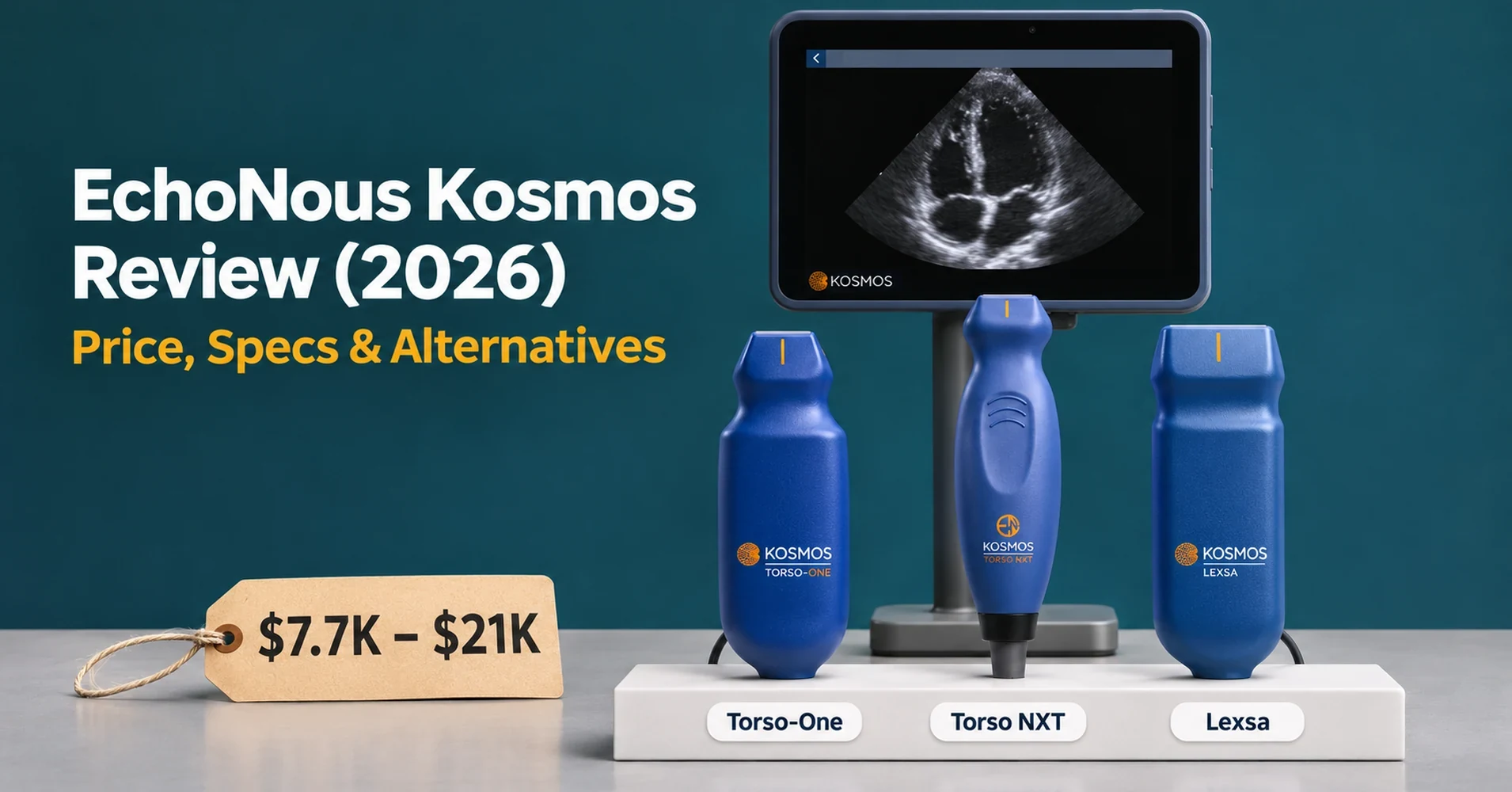
If you are looking at the Kosmos, it is probably for the Doppler. CW, PW, and Tissue Doppler on a handheld phased array is still uncommon, and EchoNous has built its whole platform around that, plus a solid set of AI tools.
The part that slows most people down is the price. EchoNous quotes by configuration and region, but its US packages start at roughly $7.7K for Kosmos Mobile and go to about $21K for Kosmos Plus. It is also a different kind of device than most handhelds: a cable-connected probe that runs on a supported tablet, not something you pair with the phone in your pocket.
Below is our honest take on what you get for that money, what has changed with the new Torso NXT, and which alternatives make sense depending on how you actually scan.
Quick Reference: Kosmos and the Alternatives at a Glance
| Appareil | Main Strength & Practical Trade-Off | Starting Price |
|---|---|---|
| EchoNous Kosmos (Torso NXT / Torso-One)Full cardiac workup incl. TDI, AI-assisted workflow | CW, PW, TDI, and Color with Auto EF and Auto Doppler. Trade-off: Wired to a supported tablet; quote-based pricing well above most handhelds. | ~$7.7K (Mobile) |
| TodoPocus™ PD2CW valve checks and FoCUS in your pocket | 120 g phased array with CW, PW, and Color, Wi-Fi or USB, $0/yr. Trade-off: No TDI or AI view guidance; single phased head. | $1,899 |
| GE Vscan Air SLHospitals that want a legacy brand | Familiar GE image quality, sector + linear, wireless. Trade-off: No CW; ~50-minute battery. | ~$4,999 |
| TodoPocus™ CD2Heart plus lines in one probe | 150 g phased + 25 mm linear, Wi-Fi or USB, $0/yr. Trade-off: PW and Color only, no CW. | $2,350 |
| Mindray TE Air i3PMindray departments that want TDI on a wireless probe | Wireless phased array; can pair with TE X carts. Trade-off: TDI and AutoEF are $500 add-ons each; TE X pairing is a $3,000 option. | $6,699 ($7,699 w/ TDI + AutoEF) |
| Butterfly iQ3Residency programs | One probe for most presets, strong teaching tools. Trade-off: Wired, no CW, and an annual plan for PW. | $3,899 |
Table des matières
Kosmos in 2026: What You Are Actually Buying

Kosmos is a platform rather than a single probe, so it helps to break it into three choices.
1. The probe
- Torso NXT (new, October 2026): EchoNous’s next-generation phased array, replacing Torso-One as the flagship. It keeps the same CW/PW/TDI Doppler suite and AI features, but the housing is about 50% smaller by volume, narrower, and has a 360° grip. The cable is still wired by design, but it is now user-replaceable with a screw-lock collar, so a worn cable no longer means shipping the probe out.

EchoNous Kosmos Torso NXT phased array: about 50% smaller by volume than Torso-One, with a 360° grip and a user-replaceable screw-lock cable (image: EchoNous). - Torso-One: The phased array most current Kosmos users own. Same Doppler modes and AI access; still listed in packages.
- Lexsa: A 38 mm linear array for vascular access, nerve, MSK, and lung. It has PW, Color, and Color Power Doppler, but not CW.
2. The screen
- Select iPad Air and iPad Pro models (M-series era, iPadOS 16+)
- Select Android tablets (Samsung, Lenovo, Xiaomi, and the rugged Kosmos Integrated Getac tablet)
- Kosmos Bridge, EchoNous’s own dedicated display
The compatibility list is all tablets, so plan on carrying one for scanning.

3. The package
Kosmos Mobile (iPad + carrying case), Kosmos Plus for Vascular Access (Lexsa + stand), and Kosmos Plus (iPad Pro + stand + full AI/Doppler). Kosmos Link is an optional dock with up to three probe ports, charge-while-scanning, and up to 8 hours of continuous scanning—useful on a stand or in an echo room, still wired.
What Kosmos Costs in 2026
EchoNous does not publish a single price list; its FAQ says pricing depends on configuration and location. Here is what it currently lists for the US:
| Forfait | What’s Included | Listed Price (USD) |
|---|---|---|
| Kosmos Mobile | Choice of probe, iPad Air or Pro, carrying case, AI tools, CW/PW/TDI/Color Doppler | From ~$7.7K |
| Kosmos Plus for Vascular Access | Lexsa, tablet, medical-grade stand, Color/CPD/PW | Under $12K |
| Kosmos Plus | Choice of probes, large iPad Pro, stand, full AI and Doppler suite | Around $21K |
A few things worth clarifying with your rep before you sign:
- How many probes do you need? If you do lines and blocks as well as echo, you are likely looking at Torso plus Lexsa.
- Torso NXT or Torso-One? NXT is new, so ask about pricing and upgrade options for existing Torso-One owners.
- Which features are included in your market? EchoNous notes that not all features are available in all regions.
- Warranty term: EchoNous lists 2- to 5-year transducer coverage depending on region (Kosmos Plus in the US advertises 5 years).

Our Take on the Kosmos
What It Does Well
The Doppler package is the real draw. CW, PW, TDI, and Color on one handheld phased array means you can check a stenotic valve, a TR jet, and annular e′ velocities without walking to a cart. For cardiology and critical care users who routinely do a diastolic workup at the bedside, that matters.
The AI is practical rather than gimmicky. Auto Doppler places PW gates at the LVOT, MV, PV, and TV and TDI gates at the septal and lateral mitral annulus, which saves real time. Auto EF returns EF, SV, cardiac output, and heart rate, with manual override of the traced borders. AI FAST labeling and Auto Preset round it out, and Kosmos also supports third-party integrations like Us2.ai reporting and 19Labs tele-ultrasound.
It is built for hospital use. Probes are IP67, rated for a 1 m drop, approved for all levels of disinfection, and made and serviced in the US. The Bridge supports DICOM worklist and store, and scanning works offline once the probe is registered.
What to Weigh
- It is wired. EchoNous treats the cable as a feature (no battery management, no wireless lag), and Torso NXT doubles down on that with a replaceable cable. That suits a stand or bedside workflow. If you want to pull a probe from your coat and scan on your phone during a rapid response, it is a different experience.
- You need a supported tablet. Budget for one if it is not in your package, and keep the platform in mind if you change devices later.
- The price adds up with a second probe. A cardiac + vascular setup puts you well past the entry price.
- Most of the premium is in TDI and AI. If you mainly do FoCUS with occasional CW, you are paying for features you may not use every day.
| Kosmos Rating | Score (out of 5) |
|---|---|
| Cardiac Image Quality | 4.5 |
| Doppler Capability | 5.0 |
| Outils d'IA | 4.5 |
| Portabilité | 3.0 |
| Rapport qualité-prix | 2.5 |
Kosmos vs. TodoPocus™ PD2: If CW Is What You Need
EchoNous describes Kosmos as the only handheld with CW Doppler. The TodoPocus™ PD2 also has CW, in a 120 g wireless phased array at $1,899—about a quarter of Kosmos Mobile’s starting price. They are not the same tool, so here is how they line up:
| EchoNous Kosmos (Torso NXT / Torso-One)Kosmos | TodoPocus™ PD2PD2 | |
|---|---|---|
| Prix | From ~$7.7K (Mobile) to ~$21K (Plus) | $1,899 |
| Doppler | CW, PW, TDI, Color, CPD | CW, PW, Color, Power |
| Mesures cardiaques | AI Auto EF (EF, SV, CO, HR), Auto Doppler | EF, SV, LVIDd/s, velocity, HR |
| AI Guidance / Labeling | Oui | Non |
| Connexion | Filaire | Wi-Fi or USB cable |
| Affichage | Select iPads, select Android tablets, Kosmos Bridge | iOS, Android & Windows phones, tablets, laptops |
| Poids | - | 120 g |
| Export | DICOM (worklist/store), JPEG, MP4 | DICOM, MP4, JPEG, PNG |
| Garantie | 2–5 years by region | 3 years + 30-day return window |

Where the PD2 makes more sense: You mainly do FoCUS and want CW for valve screening, you prefer to scan on your own phone, and you would rather not pay for TDI and AI tools you will not use daily. It also has 2.2/2.8/3.6 MHz frequency options, an 80° sector, 90–200 mm depth, and 8-level TGC, and nothing is behind a subscription.
Where the Kosmos makes more sense: You do diastolic assessment with TDI, you want Auto Doppler and Auto EF in your routine, you teach residents who benefit from AI labeling, or your department wants a stand-based setup with a longer warranty.
5 Best EchoNous Kosmos Alternatives in 2026
1. TodoPocus™ PD2 — Best Alternative If CW Doppler Is the Main Reason You Looked at Kosmos
Aperçu des caractéristiques :
- Prix : $1,899 one-time purchase ($0/year software or export fees)
- Array: 192-element phased array, 2.2 / 2.8 / 3.6 MHz, 80° sector, 90–200 mm
- Doppler & Calcs: CW, PW, Color, Power; EF, SV, LVIDd/s, velocity, HR
- Connectivité : Wi-Fi or USB cable to iOS, Android & Windows (scan while charging on USB)
- Poids : 120 g
For most clinicians who end up looking at Kosmos, the deciding feature is CW. The PD2 gives you that in a probe light enough to live in a scrub pocket, with a dedicated phased array that fits comfortably between ribs on both adults and kids.


The USB option is handy in ORs or ICUs where Wi-Fi is crowded, and since DICOM, MP4, JPEG, and PNG export are all local and included, there is no plan to renew later.
- CW, PW, and Color Doppler in a 120 g phased array, at about a quarter of the Kosmos entry price.
- Runs on phones, tablets, and Windows laptops you already own, over Wi-Fi or a cable.
- No TDI or AI view guidance, so it is not a replacement for a full diastolic workup.
- Single phased head: if you also place lines, add a linear probe or look at the CD2 below.
2. GE HealthCare Vscan Air SL — Best for Hospitals That Want a Legacy Brand
Aperçu des caractéristiques :
- Prix : ~$4,999 ($0 mandatory base fee; AI and cloud packages extra)
- Arrays: Sector (1.6–3.7 MHz) + linear (3–12 MHz) dual-head
- Connectivité & batterie : Wireless to iOS & Android; ~50-minute battery
- Weight & Build: 218 g, IP67
When value-analysis committees want a big name on the label, Vscan Air SL is usually the easiest approval. The images are clean, the app is straightforward, and you get cardiac and vascular in one wireless probe.
For Kosmos shoppers, though, the gap is obvious: there is no CW, and continuous scanning time is short.
- Sector + linear in one wireless probe with familiar GE image quality.
- No CW Doppler, so high-velocity valve jets are out of scope.
- ~50-minute battery with no wired scanning option.
3. TodoPocus™ CD2 — Best for Heart Plus Lines in One Probe

Aperçu des caractéristiques :
- Prix : $2,350 one-time purchase ($0/year software fees)
- Arrays: Phased (2.2/3.6 MHz, 9–19 cm) + 25 mm linear (7.5/10 MHz, 2–10 cm)
- Doppler & Calcs: Color, Power, PW; EF, SV, LVIDd/s
- Connectivité & batterie : Wi-Fi or USB cable (iOS, Android & Windows); ~1.5-hour wireless runtime
- Poids : 150 g
A lot of Kosmos quotes end up as Torso plus Lexsa because people want echo and vascular access. The CD2 puts a phased array on one end and a compact 25 mm linear array on the other, which covers focused echo, IJ and radial lines, DVT checks, and lung sliding.

The narrow linear footprint is easy to work with on the neck and wrist, and the USB cable mode is a practical backup on long cases.
- Phased + linear in one 150 g probe, at a fraction of a two-probe Kosmos setup.
- Wi-Fi plus wired USB for crowded hospital networks or long procedures.
- PW and Color only, no CW. If valve gradients are part of your routine, a practical setup is the PD2 plus a dedicated procedural probe such as the TodoPocus™ L10H-Guide ($2,870), which has built-in magnetic needle navigation—so you see the needle path in real time without a physical guide bracket. That is $4,769 for CW-capable echo plus a probe built specifically for lines and blocks, still well under the starting price of a single-probe Kosmos Mobile.

4. Mindray TE Air i3P — Best for Mindray Departments That Want TDI on a Wireless Probe
Aperçu des caractéristiques :
- Prix : $6,699 base (no recurring subscription); TDI +$500 and AutoEF +$500 as one-time add-ons, so $7,699 with both
- Array: Wireless phased array; cardiac, lung, abdomen, FAST, and transcranial presets
- Doppler: Color, Power, PW as standard; TDI optional
- Construction : IP68; works standalone, or pairs with Mindray TE X carts via the optional Extended Connection ($3,000)
If your department already runs Mindray carts, the i3P fits neatly into that ecosystem, and it is one of the few wireless probes you can add TDI to. Just note that TDI and AutoEF are not in the base price—both are one-time add-ons of $500 each. (More in our Mindray TE Air review.)
- TDI and AutoEF are paid add-ons: budget $7,699 if you want both, which is still a one-time cost rather than a subscription.
- TE X cart pairing is a separate $3,000 option, worth it mainly for departments already standardized on Mindray.
- Priced like a premium probe: about four times the PD2 once the cardiac add-ons are included.
5. Butterfly iQ3 — Best for Residency Programs
Aperçu des caractéristiques :
- Prix : $3,899 + $299/year (Core) or $420/year (Advanced)
- Array: Single CMUT chip, 1–12 MHz digital presets, up to 30 cm
- Connectivité & batterie : Wired to iOS & select Android; ~2-hour battery
- Poids : 300 g
Butterfly’s strength is teaching. One probe switches between cardiac, lung, abdominal, and vascular presets, and Biplane imaging plus built-in learning modules help with trainees.
For echo-focused users, it is less of a Kosmos substitute: the wide probe face is harder to angle between adult ribs, there is no CW, and PW requires the Advanced plan (see our Butterfly iQ3 review).
- One probe, many presets, and strong teaching tools.
- No CW, wired connection, and PW only on the $420/yr plan.
A Few Things Worth Checking Before You Decide
1. How often will you actually use TDI?
This is the clearest dividing line. If annular velocities and diastolic grading are part of your routine bedside exam, Kosmos (or a Mindray i3P with the $500 TDI add-on) is worth the extra money. If you check diastology occasionally and send the patient for a formal echo anyway, a CW-capable probe like the PD2 covers most of what you do.
2. Cable or no cable in your workflow?
On a stand, at a bedside, or in an echo room, a wired probe is perfectly fine and never runs out of battery. On rapid responses, in the ED, or in the field, most people find a wireless probe they can pull from a pocket easier to grab. Think about where you scan most.
3. Tablet or phone?
Kosmos runs on supported tablets. If you want to scan on your own phone or a Windows workstation, that narrows your options quickly.
4. Total probe count
Price out the setup you will really use. Echo plus lines usually means two Kosmos probes. On the handheld side, a dual-head probe like the CD2 covers both in one unit, and if you need CW as well, a PD2 + L10H-Guide pair comes to $4,769.
5. Recurring costs over 3–5 years
Some handhelds put PW, DICOM export, or AI behind an annual plan. Check what stays active if a plan lapses—our guide to handhelds with no annual fee covers this in more detail.
Bottom Line: Which One Makes Sense for You?
The Kosmos is a strong cardiac platform, and the new Torso NXT makes it more comfortable to hold through a long shift. But it is a premium, wired, tablet-based system, and much of what you pay for is TDI and AI.
- If you do routine diastolic assessment, want Auto Doppler and Auto EF, or need a stand-based department setup:
👉 Le EchoNous Kosmos is worth the quote. - If CW for valve checks plus FoCUS is what you need, on your own phone:
👉 Go with the TodoPocus™ PD2 ($1,899). - If you want heart and vascular access in one probe:
👉 Pick the TodoPocus™ CD2 ($2,350) (or pair the PD2 with the L10H-Guide for magnetic needle navigation, $4,769 total, if you also want CW). - If your hospital requires a specific brand:
Choisir GE Vscan Air SL (~$4,999) for a legacy name, or Mindray TE Air i3P ($6,699; $7,699 with TDI and AutoEF) if you already run Mindray carts.
For more cardiac options, see our roundup of portable echo machines for bedside echocardiography. If you want to compare CW Doppler clips or check PACS compatibility for a team, contactez notre équipe.
FAQ
Q: How much does the EchoNous Kosmos cost in 2026?
EchoNous prices Kosmos by configuration and region. In the US, Kosmos Mobile is listed from about $7.7K, Kosmos Plus for Vascular Access under $12K, and the full Kosmos Plus around $21K. Adding a second probe or changing the tablet changes the total, so ask for an itemized quote.
Q: What is the difference between Torso NXT and Torso-One?
Torso NXT, introduced in October 2026, is the next generation of Torso-One. It keeps the same CW, PW, TDI, and Color Doppler and AI features, but it is about 50% smaller by volume, narrower, has a 360° grip, and uses a user-replaceable cable with a screw-lock collar.
Q: Is the Kosmos the only handheld with CW Doppler?
EchoNous markets it that way, but it is no longer the only option. The TodoPocus™ PD2 also offers CW, PW, and Color Doppler in a 120 g wireless phased array for $1,899 with no subscription. Kosmos still adds TDI and AI tools that the PD2 does not have.
Q: Is the EchoNous Kosmos wireless?
No. Kosmos probes connect by cable to a supported iPad, Android tablet, or the Kosmos Bridge. EchoNous positions the wired design as a reliability choice, and Torso NXT keeps it with a replaceable cable. Kosmos Link adds multi-probe ports and longer scanning time, but it is also wired.
Q: What tablets work with Kosmos?
Select iPad Air and iPad Pro models running iPadOS 16 or later, select Android tablets from Samsung, Lenovo, and Xiaomi, the Kosmos Integrated Getac tablet, and EchoNous’s own Kosmos Bridge. Check EchoNous’s compatibility page for the current list.
Q: What is the best cheaper alternative to the Kosmos?
If CW Doppler is the main reason you considered Kosmos, the TodoPocus™ PD2 ($1,899) is the closest match. If you need both echo and vascular access in one probe, the TodoPocus™ CD2 ($2,350) fits better. If you need TDI, compare the Mindray TE Air i3P (TDI is a $500 one-time add-on) or stay with Kosmos.
Disclaimer: Pricing and specifications are based on manufacturer listings current at publication. Package contents, features, and warranty terms vary by region—always confirm with the vendor before purchasing.
Références
- EchoNous. (2026). Kosmos ultraportable ultrasound: Torso NXT, Torso-One, Lexsa, and package configurations. https://echonous.com/product/kosmos-ultraportable-ultrasound/
- EchoNous. (2026, October 19). EchoNous unveils Torso NXT, the next evolution of the Kosmos ultrasound platform. https://echonous.com/echonous-unveils-torso-nxt/
- EchoNous. (2026). Torso NXT POCUS transducer. https://echonous.com/torso-nxt/
- EchoNous. (2026). Kosmos Plus. https://echonous.com/kosmos-plus/
- EchoNous. (2026). Kosmos Mobile. https://echonous.com/kosmos-mobile/
- EchoNous. (2026). Kosmos device compatibility. https://echonous.com/product/device-compatibility/
- EchoNous. (2026). Kosmos AI: Auto EF, Auto Doppler, AI FAST, Auto Preset, and Bladder AI. https://echonous.com/product/kosmos-ai/
- EchoNous. (2026). Kosmos Link. https://echonous.com/kosmos-link/
- EchoNous. (2026). Frequently asked questions. https://echonous.com/frequently-asked-questions/
- Spencer, K. T., Kimura, B. J., Korcarz, C. E., Pellikka, P. A., Rahko, P. S., & Siegel, R. J. (2013). Focused cardiac ultrasound: Recommendations from the American Society of Echocardiography. Journal of the American Society of Echocardiography, 26(6), 567–581. https://doi.org/10.1016/j.echo.2013.04.001
- Baumgartner, H., Hung, J., Bermejo, J., et al. (2017). Recommendations on the echocardiographic assessment of aortic valve stenosis. Journal of the American Society of Echocardiography, 30(4), 372–392. https://doi.org/10.1016/j.echo.2017.02.009
- TodoPocus. (2026). PD2 phased-array handheld ultrasound with CW Doppler. https://todopocus.com/phased-probe-handheld-ultrasound/pd2/
- TodoPocus. (2026). CD2 phased + linear dual-probe handheld ultrasound. https://todopocus.com/multipurpose-handheld-ultrasound/cd2/
- GE HealthCare. (2026). Vscan Air SL wireless handheld ultrasound. https://www.gehealthcare.com/products/ultrasound/handheld-ultrasound/vscan-air-sl
- Mindray North America. (2026). TE Air wireless handheld ultrasound. https://mindrayna.my.site.com/teair/product-details
- Butterfly Network. (2026). Butterfly iQ3. https://www.butterflynetwork.com/iq3

